
Reconstruction: Competing Visions for the U.S., 1865-1892
Inquiry Question 1: What were the goals and achievements of Reconstruction for different groups of people, including: freedpeople, Radical Republicans, white Southerners, and moderate Northern Republicans?
Inquiry Question 2: What did backlash to Radical Reconstruction look like?
Inquiry Question 3: How should we remember Reconstruction today?
Background Reading for Students
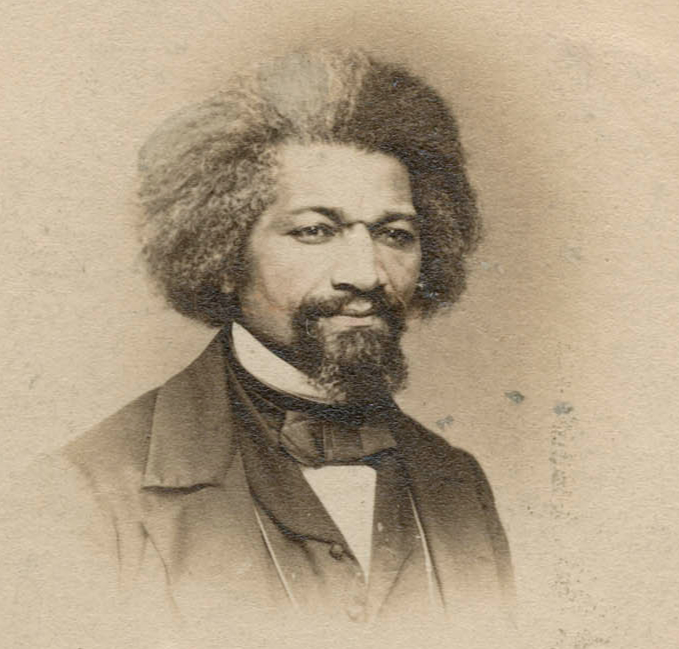
“What the Black Man Wants,” Frederick Douglass's speech to the Massachusetts Anti-Slavery Society, Boston,1865
While the 13th amendment had officially freed enslaved people throughout the nation, it was not yet clear what tangible freedom would look like. In 1865, Frederick Douglass gave a speech at the annual meeting of the Massachusetts Anti-Slavery Society to argue for Civil Rights[rights that citizens are guaranteed by their government through laws and enforced though government action] legislation. Douglass notes how freedom means nothing if Black people are not given the same rights as white citizens -- especially the right to vote -- and if those rights are not protected under federal law.
Image citation: Frederick Douglass, Carte de visite taken by J. W. Hurn, circa 1864-1865, from the DeGrasse-Howard photos, Massachusetts Historical Society, https://www.masshist.org/database/5970.
Quote citation: The equality of all men before the law: claimed and defended / in speeches by Hon. William D. Kelley, Wendell Phillips, and Frederick Douglass, and letters from Elizur Wright and Wm. Heighton; Boston: Pres of Geo. C. Rand & Avery, 1865.
If we know enough to be hung, we know enough to vote. If the negro knows enough to pay taxes to support the government, he knows enough to vote; taxation and representation should go together. If he knows enough to shoulder a musket and fight for the flag, fight for the government, he knows enough to vote…I hold that the American people are bound, not only in self-defence, to extend this right to the freedmen of the South, but they are bound by their love of country, and by all their regard for the future safety of those Southern States, to do this – to do it as a measure essential to the preservation of peace there.
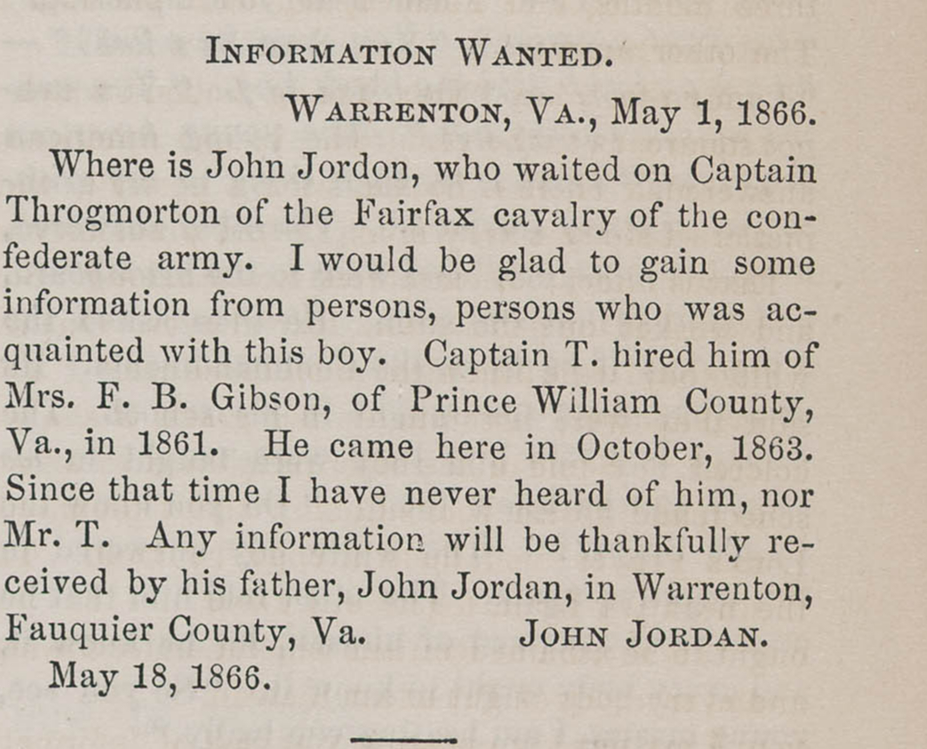
Freedman John Jordan seeks to find his son, May 1866
Following the end of the war, freedpeople[formerly enslaved people who became legally free following the passage of the 13th Amendment in 1865] worked to reunite with family members from whom they had been separated by enslavers. They placed ads in Black newspapers and that could be shared across Black churches. They also sought help from the Freedmen's Bureau, a government organization, and private aid organizations such as the New England Freedmen's Aid Society. In this ad, a man named John Jordan in Warrenton, Virginia, seeks to find his son who he has not seen for three years. This ad ran in The Freedmen's Record, which was published by the New England Freedmen's Aid Society. Above his ad, ran a letter from W.A. McNulty, Assistant Superintendent of the Freedmen’s Bureau in this area, who connected Jordan with the Freedmen’s Aid Society.
Additional context: On March 3, 1865, Congress established the Bureau of Refugees, Freedmen, and Abandoned Lands (often termed “The Freedmen’s Bureau”). Congress tasked the Bureau with a number of duties such as providing medical care to formerly enslaved people, distributing land to freedmen, creating and staffing schools, and providing basic necessities such as food, shelter, and clothing. The Bureau also aided formerly enslaved people in locating family members and, under specific conditions, provided marriage certificates to formerly enslaved spouses, whose marriages during slavery were not considered legal by the U.S. The agency proved to be critical in the creation and protection of rights for formerly enslaved people in the South. The Bureau was officially abolished in 1872. When these federal protections of civil rights ended, it became much more difficult for freedpeople[formerly enslaved people who became legally free following the passage of the 13th Amendment in 1865] to access high-quality education and medical care.
See the full newspaper issue in which this ad appeared. (The ad is on page 15.)
Citation: Letter (published transcript) from W. A. McNulty to Hanna Stevenson, 26 May 1866 and enclosure (published transcript) from John Jordan requesting information about his son, John Jordan. From The Freedmen's Record, June 1866, Vol. 2, No. 6, detail of page 119, Massachusetts Historical Society, www.masshist.org/database/7878
“Where is John Jordon, who waited on Captain Throgmorton of the Fairfax cavalry of the confederate army. I would be glad to gain information from persons, persons who was acquainted with this boy... He came here [Warrenton, VA] in 1863. Since that time I have never heard of him, nor Mr. T. [Jordan’s former enslaver]. Any information will be thankfully received by his father…”
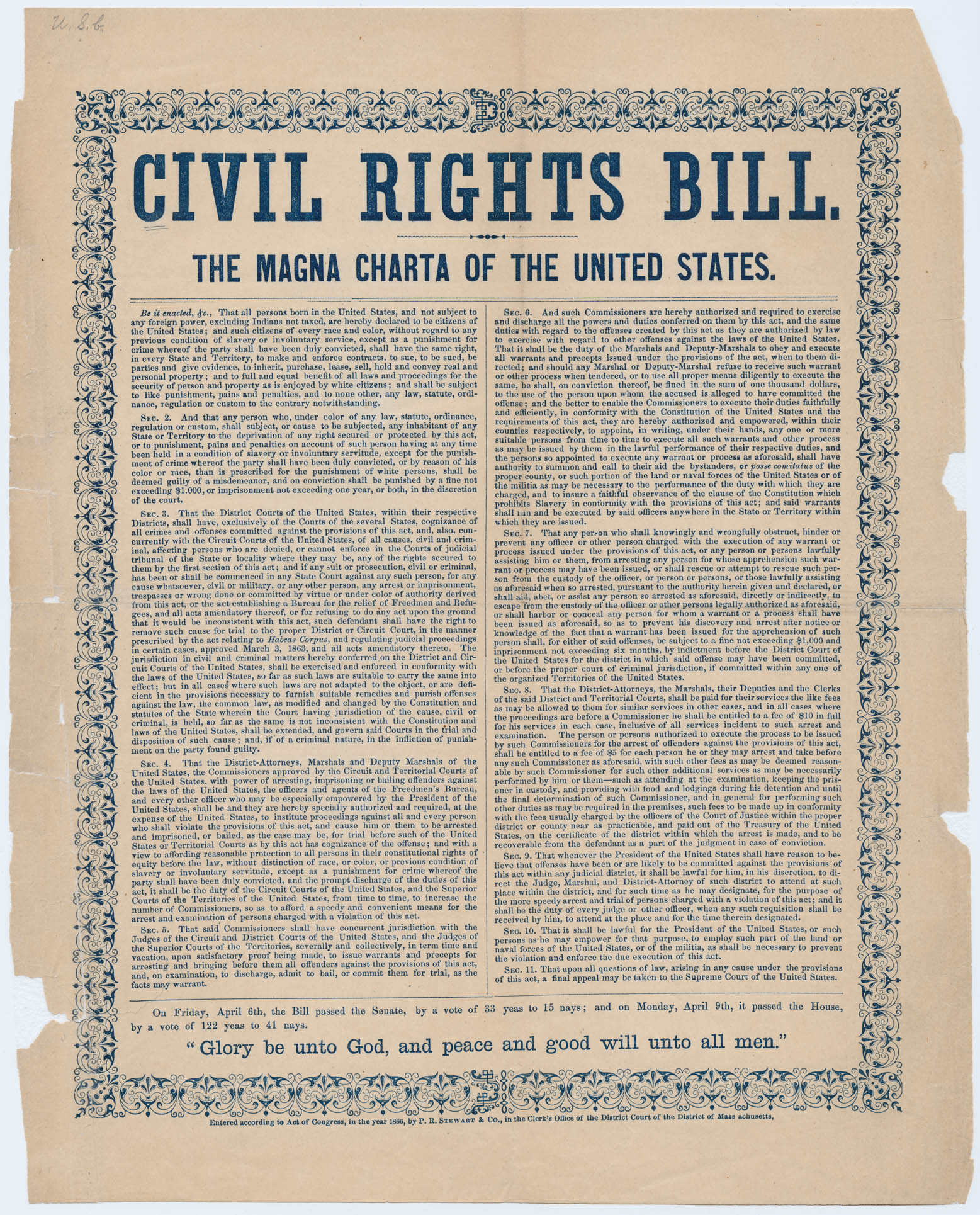
The 1866 Civil Rights Act
The 1866 Civil Rights[rights that citizens are guaranteed by their government through laws and enforced though government action] Act was the first Civil Rights[rights that citizens are guaranteed by their government through laws and enforced though government action] law in the United States. Although President Andrew Johnson vetoed the bill, the Senate and House of Representatives overrode his veto 33-15 and 122-41, respectively. It gave all people citizenship, regardless of race or previous condition of slavery or involuntary servitude, and provided for the conviction and punishment of those who violated the law.
Citation: Civil Rights Bill: The Magna Charta of the United States, Broadside by P. R. Stewart & Co., Mass., 1866, Massachusetts Historical Society, www.masshist.org/database/7858
Be it enacted, etc., That all persons born in the United States, and not subject to any foreign power, excluding Indians not taxed, are hereby declared to be citizens of the United States; and such citizens of every race and color, without regard to any previous condition of slavery or involuntary service, except as a punishment for crime whereof the party shall have been duly convicted, shall have the same right, in every State and Territory, to make and enforce contracts, to sue, to be sued, be parties and give evidence, to inherit, purchase, lease, sell, hold and convey real and personal property; and to full and equal benefit of all laws and proceedings for the security of person and property as enjoyed by white citizens
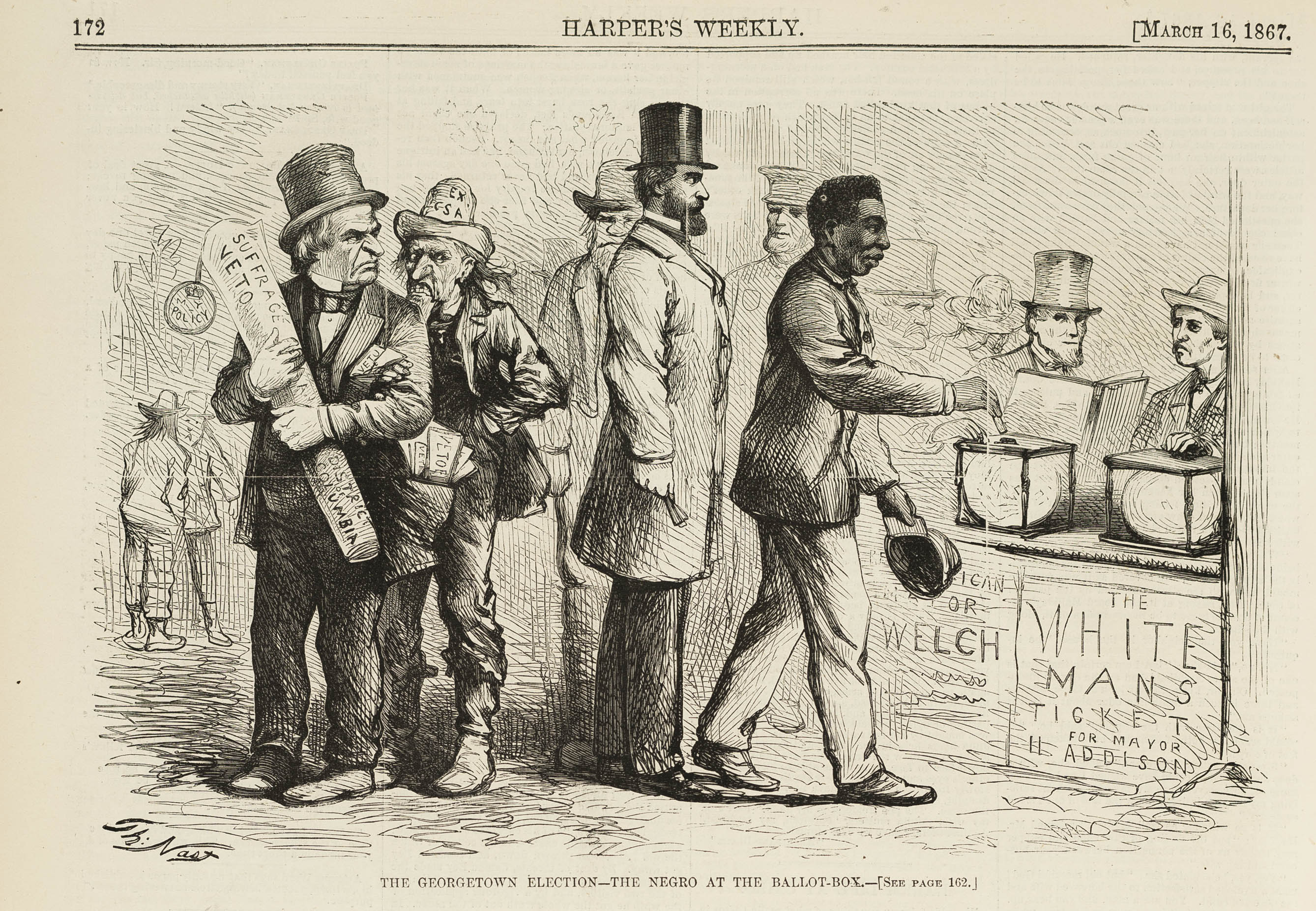
President Johnson opposes suffrage for Black men; as shown in 1867 political cartoon by Thomas Nast
Andrew Johnson’s tenure as President of the United States (1865-1869) is best characterized through his leniency toward former Confederate officials, his racist opposition to Civil Rights[rights that citizens are guaranteed by their government through laws and enforced though government action] for Black Americans, and his push to bring Reconstruction[the period after the Civil War when the southern states returned to the U.S. and laws were passed that gave rights to Black Americans] to a swift conclusion. He opposed legislation such as the Civil Rights Act of 1866 and pardoned numerous Confederate soldiers and officials, angering those Black and white Americans who understood the protection and expansion of Black rights to be the most important piece to Reconstruction[the period after the Civil War when the southern states returned to the U.S. and laws were passed that gave rights to Black Americans].
In this political cartoon, Thomas Nast, a Northern white artist during the Civil War era, considers the many flaws of Johnson’s Reconstruction[the period after the Civil War when the southern states returned to the U.S. and laws were passed that gave rights to Black Americans] plan through the creation of an election day scene in the Georgetown neighborhood of Washington, DC.
Compare this cartoon to one drawn by the cartoonist A.R. Waud: the first election in which Black men voted in Virginia.
Citation: "The Georgetown Election--The Negro at the Ballot-Box." Engraving of political cartoon drawn by Thomas Nast. From Harper's Weekly, 16 March 1867, page 172. Massachusetts Historical Society, www.masshist.org/database/5882
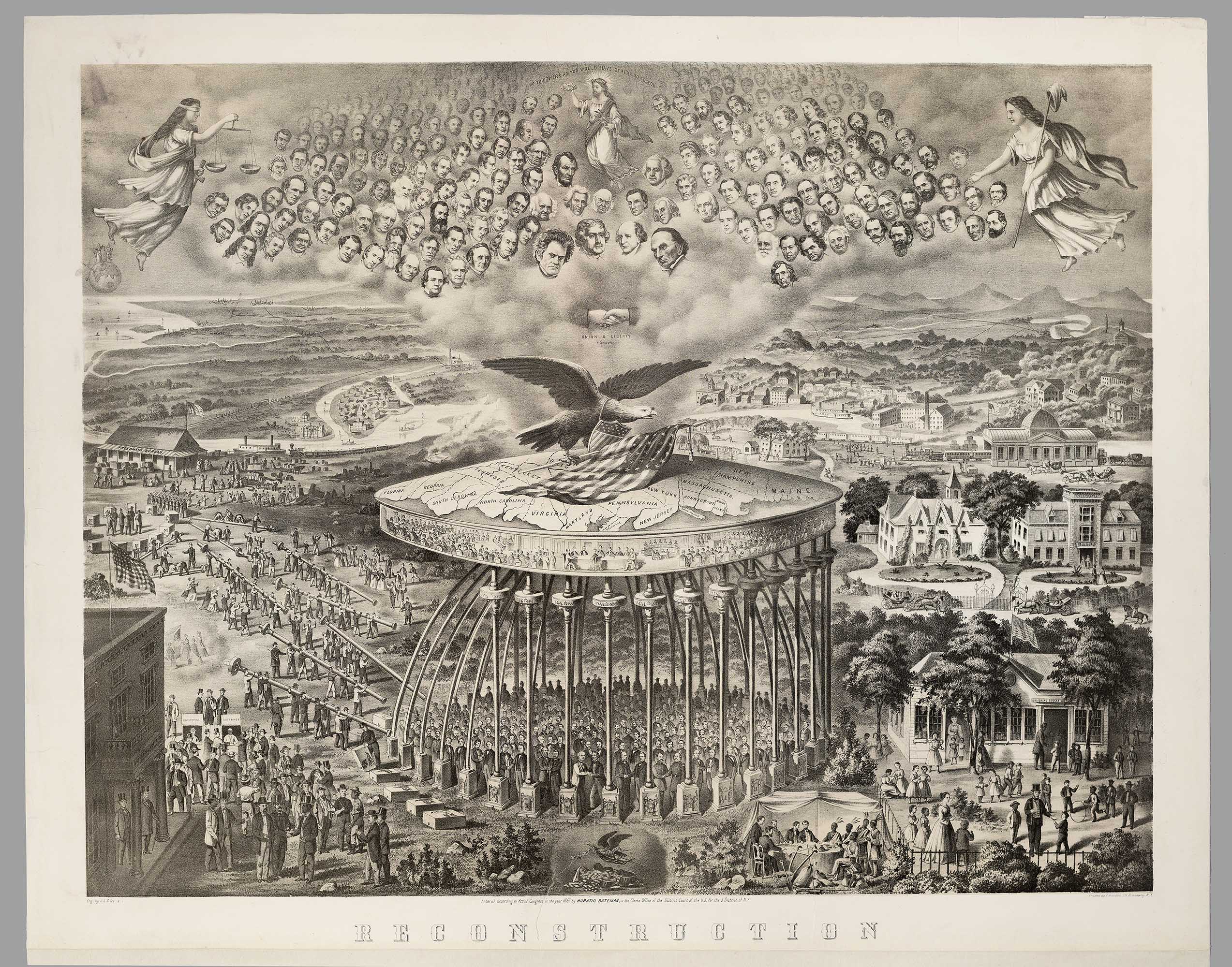
Imagining Reconstruction, 1867
While Reconstruction[the period after the Civil War when the southern states returned to the U.S. and laws were passed that gave rights to Black Americans] most significantly meant the freeing of enslaved people across the South, many White Northerners hoped for a quick reunion of North and South. This lithograph imagines a North and South reuniting physically, economically, and ideologically, highlighting the importance of sectional reconciliation over granting rights to people of color.
What is included in this image? What seems to be left out? What do these inclusions and exclusions suggest about the meaning of Reconstruction?
The idea of reconciliation[a process to restore the relationship between the North and South] grew to be the dominant memory of the Civil War after the close of Reconstruction[the period after the Civil War when the southern states returned to the U.S. and laws were passed that gave rights to Black Americans]. White Northerners and Southerners abandoned the project of granting and protecting Black rights for the idea of economic progress, leading to a significant physical threat to multiple generations of Black Americans.
Citation: Reconstruction, Lithograph engraved by J.L. Giles N.Y., [New York] : Printed by F. Ratellier, 171 Broadway, N.Y., [1867], Massachusetts Historical Society, www.masshist.org/database/4234
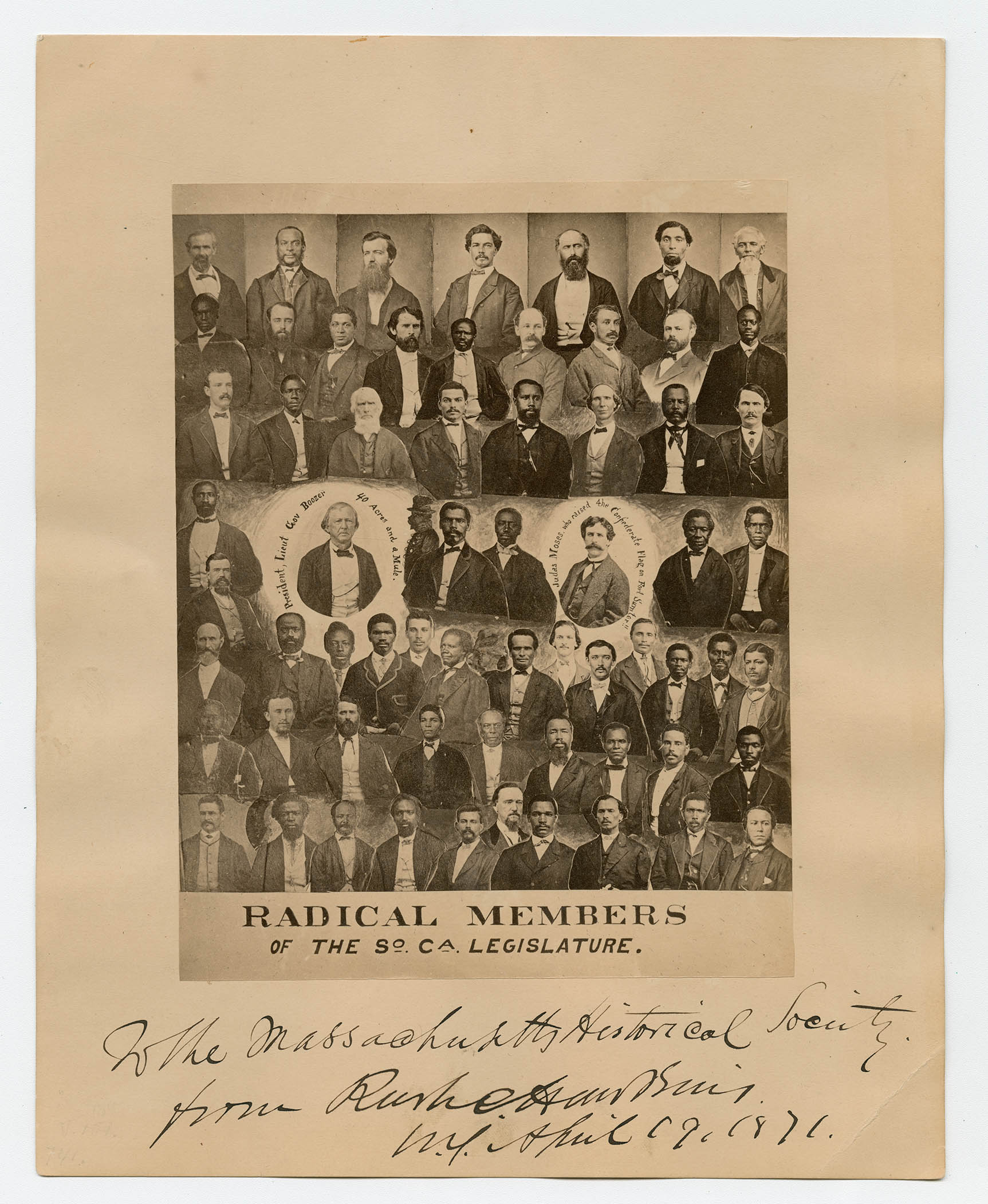
Black and white elected officials of the 1868 South Carolina Legislature
In 1868, Black Americans worked to create a new constitution for the State of South Carolina, which removed the racial and property barriers to the right to vote. As a result, one of the most extraordinary gains for formerly enslaved people during Reconstruction[the period after the Civil War when the southern states returned to the U.S. and laws were passed that gave rights to Black Americans] was their ability to hold political office nationally and within states. This photograph of the South Carolina legislature illustrates how freedpeople capitalized on their new political rights: 50 of the 64 men shown here are Black. This photo was made and distributed by opponents of Radical Reconstruction[led by Republicans in Congress who opposed Andrew Johnson and worked to protect the civil rights of Black Americans]; a caption on some copies of this image attempted to depict the Black legislators as unqualified and falsely claimed most did not pay taxes. The image was meant to scare white Southerners about the ways in which Reconstruction[the period after the Civil War when the southern states returned to the U.S. and laws were passed that gave rights to Black Americans] was reshaping the region.
In 1876, Southern White Democrats led by former Confederate general Wade Hampton would retake control of the South Carolina legislature, ushering in the era of Jim Crow. Between 1902 and 1970, all representatives in the South Carolina legislature were white.
Citation: “Radical Members of the SoCa Legislature,” 1871 (composite photograph), Massachusetts Historical Society, www.masshist.org/database/7853
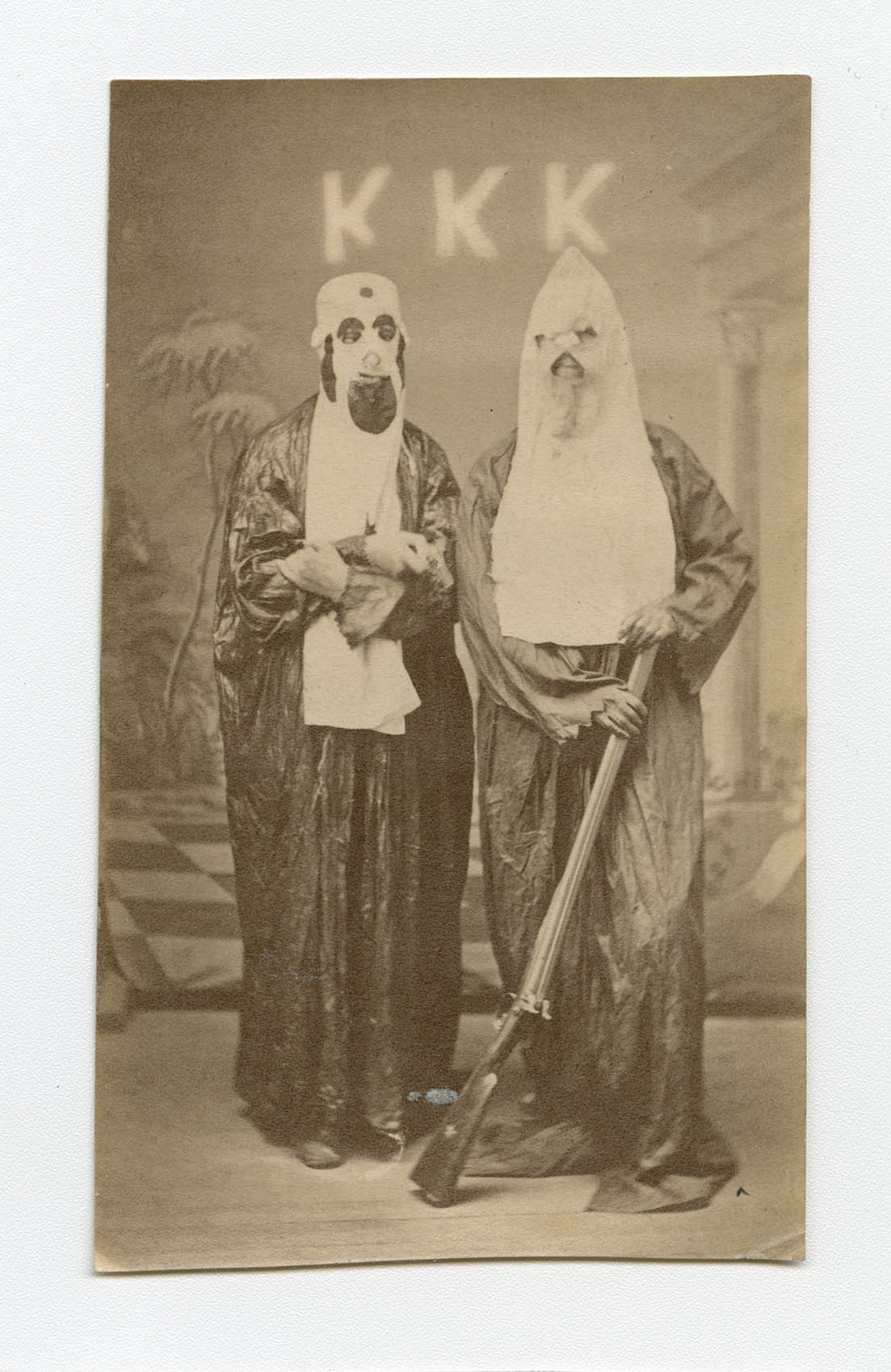
Disguises of the Ku Klux Klan (KKK), Huntsville, Alabama, 1868-1869
The Ku Klux Klan (KKK) was founded in the aftermath of the Civil War. Members in ‘dens’ across the South used vigilante violence to try to prevent freedpeople[formerly enslaved people who became legally free following the passage of the 13th Amendment in 1865] from voting, running for office, and engaging in social activities alongside white people. Members of the KKK used such violence to try to reinstate and reinforce the racial hierarchy which had characterized the antebellum South.
This photo was taken in a photographic studio in Huntsville, Alabama in late 1868 or early 1869. The photograph was taken by U.S. Army investigators in order to document the weapons and disguises of the KKK. The U.S. officials were investigating Klan violence during a riot that disrupted a Republican political rally before the presidential election of 1868. Klansmen on horseback paraded – and eventually rioted – in front of the attendees to instill fear in and try to prevent Black men and white Republicans from voting for Ulysses S. Grant. The “KKK” letters above the men’s heads were printed onto the photo and were not part of the studio backdrop.
Citation: Two men in Ku Klux Klan disguises, Carte de visite by Robinson & Murphy, 1868 or 1869, Massachusetts Historical Society, www.masshist.org/database/7859
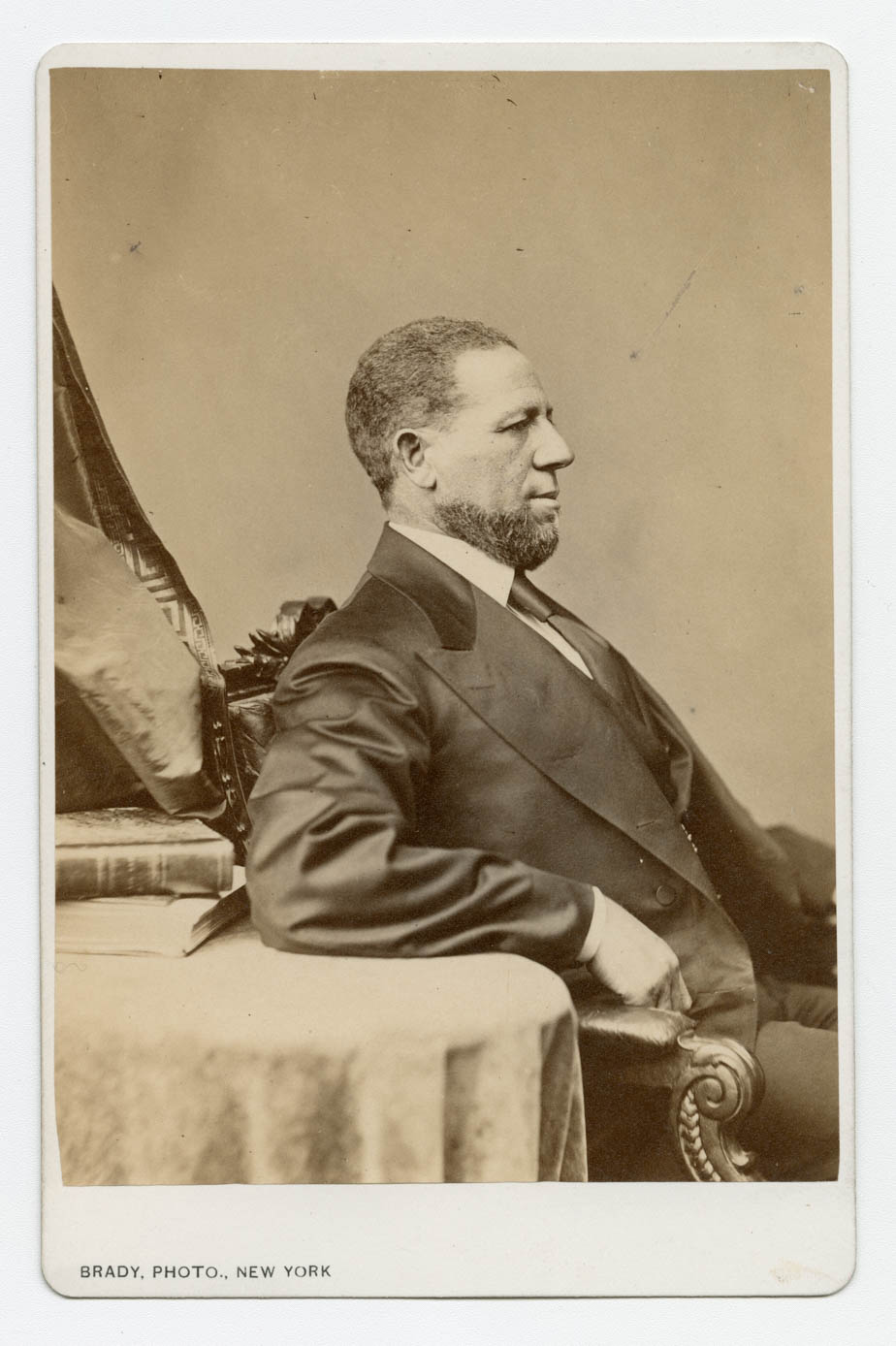
Senator Hiram Revels of Mississippi makes his first speech on the U.S. Senate floor, March 1870
Hiram Revels of Mississippi was the first Black man to serve in Congress and in the Senate. He was sworn into office in Washington, D.C., on February 25, 1870. Revels had been born a free man in North Carolina and received both formal schooling and a religious education. Formerly enslaved people also held offices in the national Senate and House of Representatives.
Senator Revels delivered his first speech on the floor of the U.S. Senator on March 16, 1870 regarding the question of readmitting Georgia to the Union. In the quote excerpted below, Senator Revels argues for the need for the federal government to continue to protect Black southerners so that they may enjoy the rights of freedom and citizenship, including voting and holding elected office, granted to them by the 13th, 14th, and 15th Amendments.
Image Citation: Hiram Revels, Carte de visite by Mathew B. Brady, [1870s], Massachusetts Historical Society, www.masshist.org/database/7860
Quote Citation: “The State of Georgia,” speech delivered by Hiram R. Revels on the floor of the U.S. Senate, March 16, 1870, https://www.senate.gov/artandhistory/history/resources/pdf/RevelsGeorgia.pdf
[Black southerners] aim not to elevate themselves by sacrificing one single interest of their white fellow-citizens. They ask but the rights which are theirs by God's universal law, and which are the natural outgrowth, the logical sequence of the condition in which the legislative enactments of this nation have placed them. They appeal to you and to me to see that they receive that protection which alone will enable them to pursue their daily avocations with success and enjoy the liberties of citizenship on the same footing with, their white neighbors and friends. I do not desire simply to defend my own race from unjust and unmerited charges, but I also desire to place upon record an expression of my full and entire confidence in the integrity of purpose with which I believe the president, Congress, and the Republican party will meet these questions so prolific of weal or woe, not only to my own people, but to the whole South….Let the reconstruction enactments answer the interrogation. No poor words of mine are needed to defend the wise and beneficent legislation which has been extended alike to white and colored citizens.
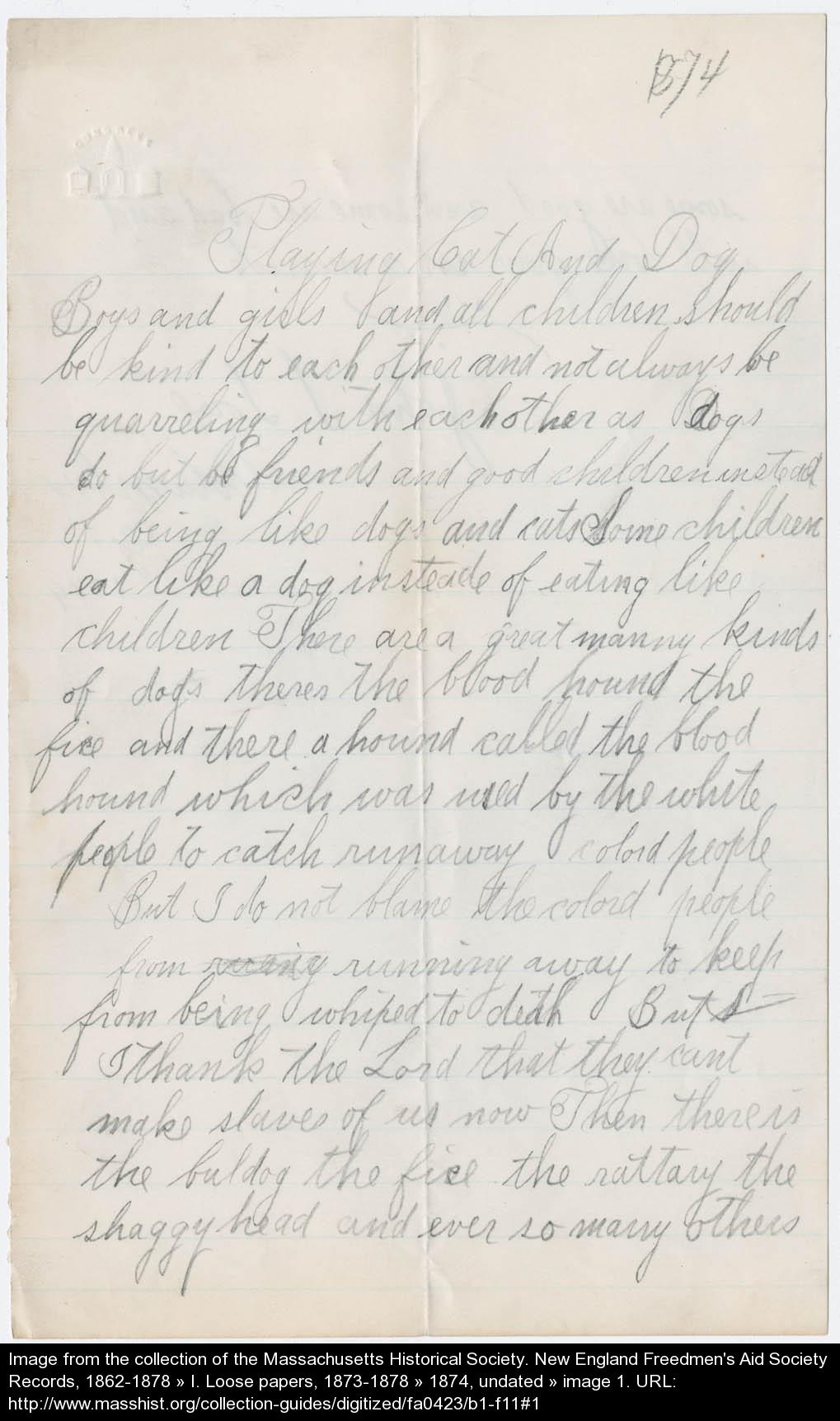
11-year-old John L. Love's student essay, Columbus, GA, 1874
One major priority of Reconstruction was the education of formerly enslaved people, and their children. In 1874, John L. Love was an 11-year-old student at the Claflin School in Columbus, Georgia. The Claflin School was run by the New England Freedmen’s Aid Society. To support the school’s operating costs, students paid tuition to attend.
In surviving examples of schoolwork, Claflin School students wrote essays on books they had read and summarized daily lessons they had been taught. John Love’s student essays often connected lessons to his own life. In this essay, which he titled ‘Playing Cat and Dog,’ Love describes one way in which life has changed for Black people with the end of slavery, and is an example of the ways in which formerly enslaved communities passed on the meaning of freedom to Black children.
The New England Freedmen's Aid Society was founded in Boston, MA and operated from 1862-1874. Its mission was to provide teachers and other aid for freedpeople.
Citation: New England Freedmen’s Aid Society Records, 1862-1878, Massachusetts Historical Society
...there’s a hound called the bloodhound which was used by the white people to catch runaway colored people. But I do not blame the colored people from running away to keep from being whipped to death. But I thank the Lord that they can’t make slaves of us now.
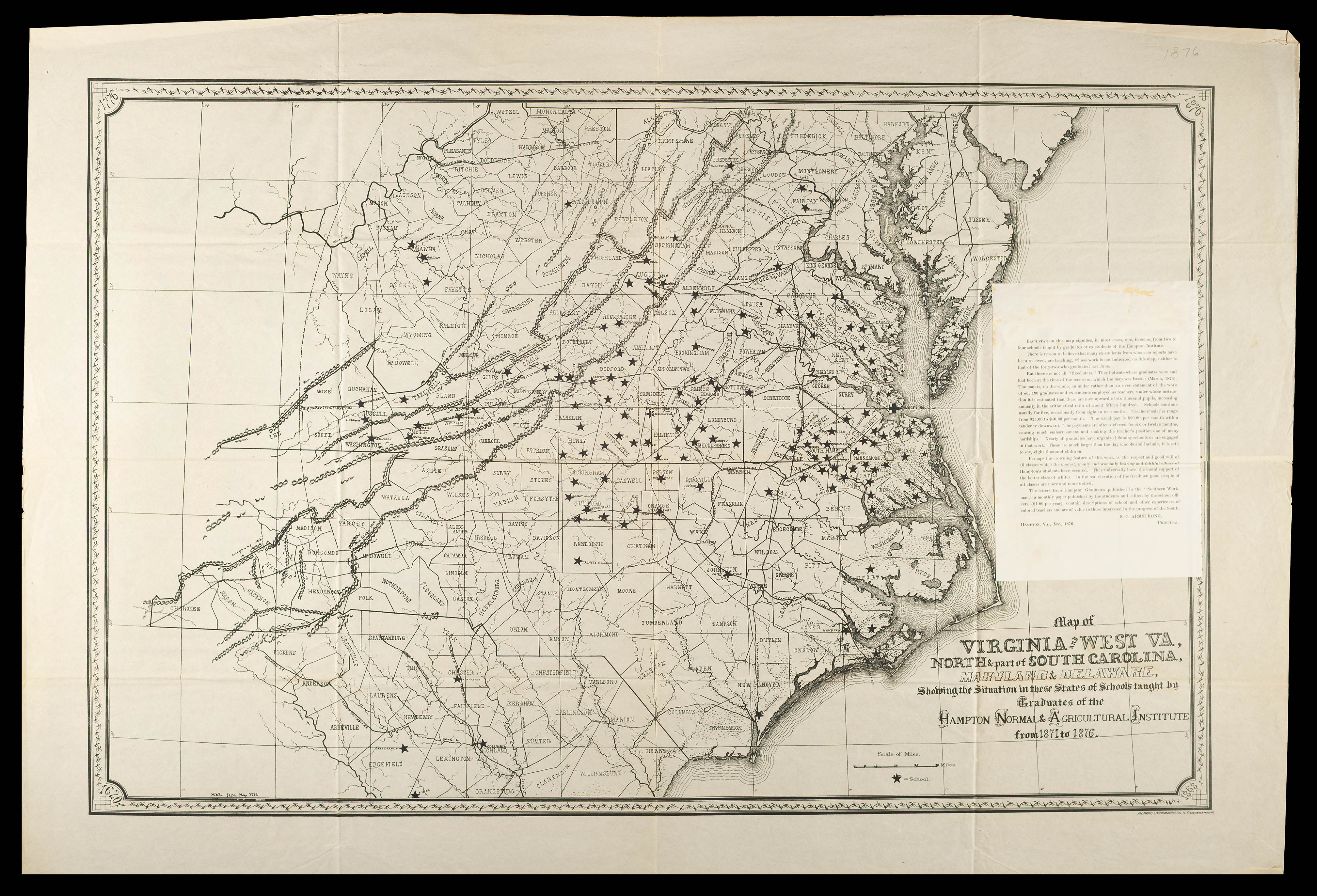
Hampton Institute (Hampton, VA) map of Black graduates' teaching positions, March 1876
Many of the schools known today as Historically Black Colleges & Universities (HBCUs), including Howard University in Washington, D.C., Fisk University in Nashville, TN, and Hampton University in Hampton, VA, were founded during Reconstruction[the period after the Civil War when the southern states returned to the U.S. and laws were passed that gave rights to Black Americans] to educate Black women and men to be teachers.
This map, printed in March 1876, shows part of the U.S. South and uses stars to identify the schools where graduates and ex-students from Hampton Institute were known to be teaching. The map shows how successful Black institutions of higher learning were in creating educators for the next generation of Black children.
Citation: Map of Virginia and West Virginia, North & part of South Carolina, Maryland, and Delaware, showing the situation in these states of schools taught by graduates of the Hampton Normal and Agricultural Institute from 1871-1876, N.Y. : Am. Photo-Lithographic Co., [1876], Massachusetts Historical Society, www.masshist.org/database/7862
Each star on this map signifies, in most cases one, in some, from two to four schools taught by graduates or ex-students of the Hampton Institute. The map is, on the whole, an under rather than over statement of the work of our 190 graduates and ex-students employed as teachers, under whose instruction it is estimated that there are now upward of six thousand pupils…
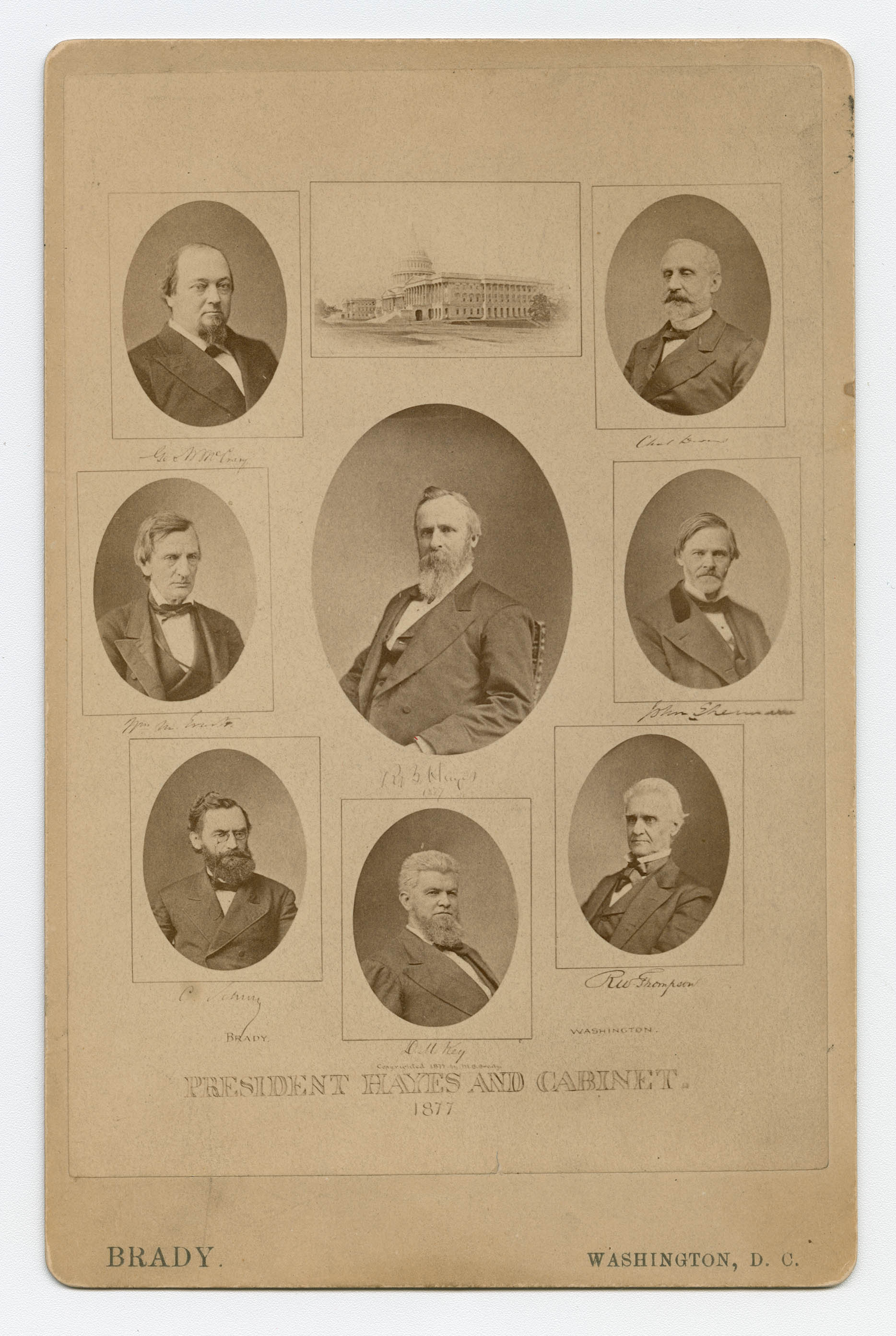
President Hayes withdraws remaining troops from the South, 1877
The unofficial, unwritten deal known as the Compromise of 1877 made Rutherford B. Hayes the 19th President of the United States with the understanding that he would remove the remaining federal troops stationed in Florida, South Carolina, and Louisiana. This 1877 photograph depicts President Hayes and the members of his Cabinet. With the removal of troops, the project of Reconstruction[the period after the Civil War when the southern states returned to the U.S. and laws were passed that gave rights to Black Americans] effectively ended, as the presence of federal troops prevented white Southerners from engaging in widespread violence to prevent Black Americans from voting, holding public office, and serving on juries.
In a speech delivered in Woodstock, CT, on the 4th of July 1877, Daniel Chamberlain describes the ways in which the removal of troops will roll back the gains achieved by Black people, and the Republican party, in the South during Reconstruction[the period after the Civil War when the southern states returned to the U.S. and laws were passed that gave rights to Black Americans]. Chamberlain was a Union Army veteran from Massachusetts who served as the Governor of South Carolina from December 1874 - April 1877.
Image Citation: President Hayes and Cabinet, Carte de visite by Brady’s National Photographic Portrait Galleries, 1877, Massachusetts Historical Society, www.masshist.org/database/7861
Quote citation: President Hayes’s southern policy / Speech of Daniel H. Chamberlain delivered at Woodstock, Conn., July 4th, 1877. New York: Press of John Polhemus, 1877.
But, fellow-citizens, what is the President’s Southern Policy? In point of physical or external fact, it consists in, withdrawing the military forces of the United States from the points in South Carolina and Louisiana where they had been previously stationed for the protection and support of the lawful governments of those States. [...] In point of actual present results, it consists in the abandonment of Southern Republicans, and especially the colored race, to the control and rule not only of the Democratic Party, but of that class at the South which regarded slavery as a Divine Institution, which waged four years of destructive war for its perpetuation, which steadily opposed citizenship and suffrage for the negro–in a word, a class whose traditions, principles and history are opposed to every step and feature of what Republicans call our national progress since 1860.
Daniel Chamberlain, speech delivered at Woodstock, CT, July 4th, 1877
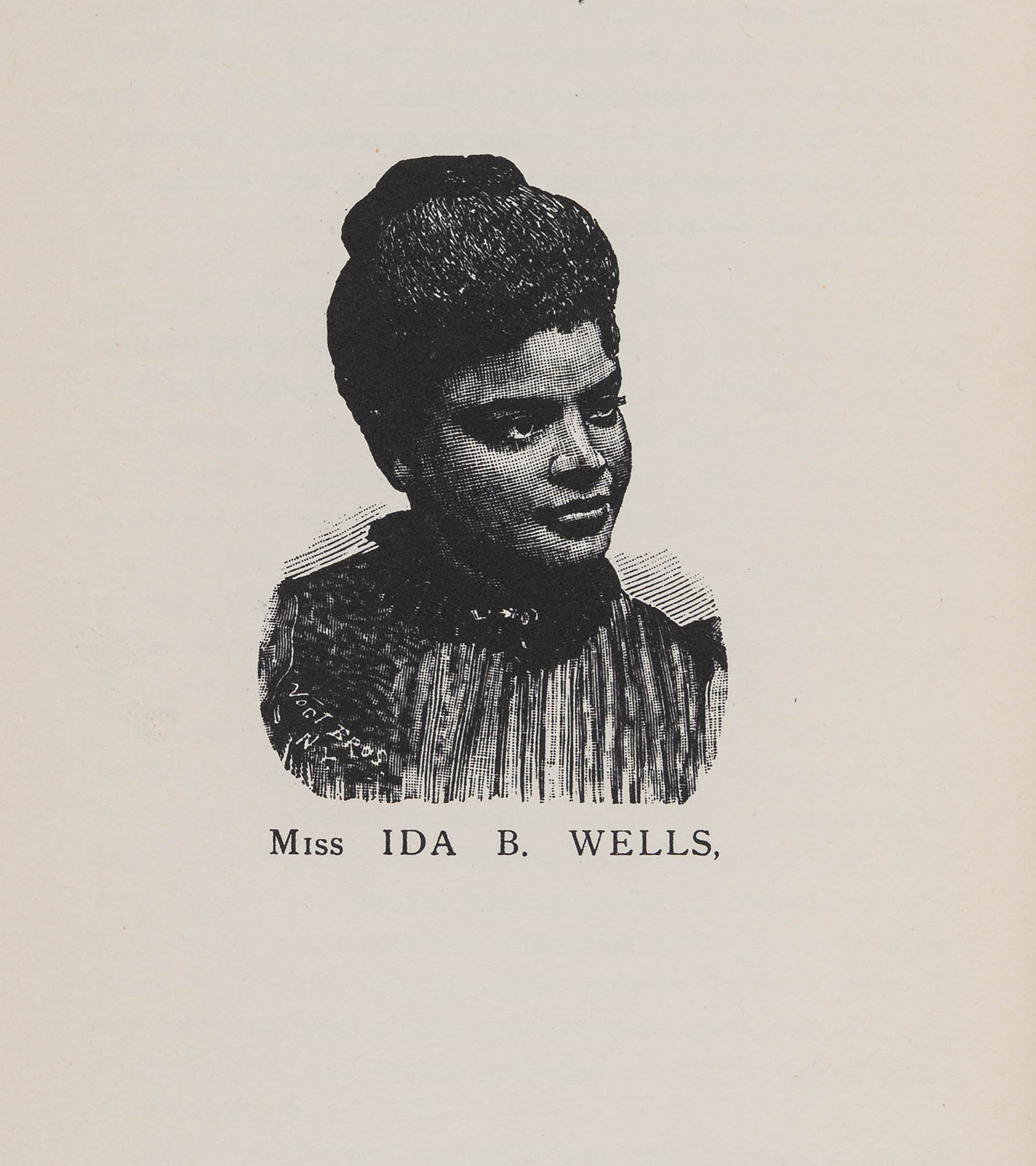
Investigative Journalist Ida B. Wells Publishes Southern Horrors, 1892
In 1892, journalist Ida B. Wells published Southern Horrors, an investigation into the rise of the lynching of Black people (particularly Black men) in the United States. In the preface to her book, Wells describes her efforts to demand justice for the murdered and to achieve protections for Black communities. She thanks Black women in Brooklyn and New York for making her work possible and also prints a letter of support written by Frederick Douglass. Wells published her book just months after the offices of the newspaper she co-owned, the Memphis Free Speech, had been burned down by white people in Memphis. Her work launched a decades-long push to pass federal legislation to prevent lynching and other violent hate crimes in the United States; however, no such legislation was passed until 2022.
Citation: From On lynchings : Southern horrors ; A red record ; Mob rule in New Orleans by Ida B. Wells-Barnett. New York : Arno Press, 1969. This image depicts a 1969 facsimile reprint of the preface to the pamphlet Southern Horrors by Ida B. Wells, 1892. Although this preface, originally published in 1892, is reproduced in facsimile in a work under copyright published in 1969, it is in the public domain and can be used without permission from the rights-holder for educational purposes.
[This statement] is a contribution to truth, an array of facts, the perusal of which it is hoped will stimulate this great American Republic to demand that justice be done though the heavens fall…If this work can…arouse the conscience of the American people to a demand for justice to every citizen, and punishment by law for the lawless, I shall feel I have done my race a service.
Historical Overview: Reconstruction
Introduction to Reconstruction
Read the essay on Google Docs.
Reconstruction is broadly defined as three simultaneous efforts: bringing the eleven Confederate states that had seceded from the Union back into the United States; the abolition of slavery across the nation; and the introduction and protection of Black civil and political rights into federal, state, and local laws. Scholars are currently debating when exactly Reconstruction began and ended, as there were some places within the Confederacy that had essentially abolished slavery (through control of Union troops) and were beginning to be reincorporated before the close of the War. While some areas in the South that were under Union military control before the end of the Civil War in 1865 witnessed fits and starts of Reconstruction, it began across the entire South after General Robert E. Lee surrendered at Appomattox. The process of reincorporating the South into the nation without the institution of slavery involved the cooperation, negotiation, and opposition of people across the nation. Freedpeople steered the way for determining the meanings of freedom by voting, holding public office, working their own hours, obtaining an education, and reconstituting their families. Alongside Radical Republicans in Congress, they demanded laws that created and protected their civil rights. Many White Northerners and Southerners, on the other hand, opposed granting African Americans full rights and citizenship, creating strong pushback against Radical Reconstruction policies. In the case of the South, opposition to social, economic, and political equality often took the form of racial violence with the rise of the Ku Klux Klan. While every individual had a different relationship to Reconstruction and its varied meanings, there are four main categories of opinions: southern Black people, including the formerly enslaved; White Southerners; Radical Republicans; and, Conservative or Moderate Republicans in the North.
Freedpeople
Broadly speaking, freedpeople understood Reconstruction to be about civil rights and personal autonomy–a lived experience that meant different things to different people. Emancipation was a dramatic reversal of the institution of slavery in nearly every way possible. Freedpeople now had the ability to choose when they worked, what kinds of jobs they did (although this was often quite limited), where they did those jobs, and in some cases, they even negotiated their pay. In contrast to slavery, when enslavers often ripped apart enslaved families with the stroke of a pen, freedpeople worked to find their loved ones; legally married their spouses , and felt secure that their partners and children would not be forcibly moved elsewhere in the country. Additionally, they enjoyed educational opportunities that enslavers had systematically denied them before the Civil War as Northerners worked to create schools for children and institutions of higher learning throughout the South. Many of the schools known today as Historically Black Colleges & Universities (HBCUs), including Howard University in Washington, D.C., Fisk University in Nashville, TN, and Hampton University in Hampton, VA, were founded by the Freedmen’s Bureau during Reconstruction and helped to grow the Black professional class. These schools were co-educational; Spelman College in Atlanta, GA was founded for Black women in 1881.
Perhaps most significantly, freedpeople gained the right to vote and hold office, and they led the charge to rewrite state constitutions. Political figures such as whitefield J. McKinlay, Charles McDuffie Wilder, James P. Mayes, Joseph Hayne Rainey, and John B. Wright spearheaded the effort to rewrite the State Constitution in South Carolina in 1868, for example. Formerly enslaved people also held offices in the national Senate and House of Representatives. In 1870, Hiram Revels of Mississippi became the first Black Senator in the United States, while Blanche Bruce of Mississippi was the first and only senator to be formerly enslaved. These men joined representatives such as Robert Smalls, Joseph Rainey, Jefferson F. Long, Benjamin S. Turner, and Josiah T. Wells (among many others).
Freedpeople were always active agents in their own experiences of freedom (even prior to legal emancipation with the 13th Amendment), and their encounters with freedom ranged from holding office to seemingly mundane activities such as wishing for gifts for Christmas. It was often in these seemingly small moments, such as wearing a dress made of good-quality material, that freedpeople experienced and witnessed their freedom. Freedpeople could choose their own clothes, partners, activities, and jobs. They could also choose to quit those jobs. In her book We Refuse, Dr. Kellie Carter Jackson describes the difficult and poorly paid work of Black domestics in the 1870s, and the joy freedwomen felt in the act of quitting a job or a task. She writes, “Slavery denied consent. Saying no was not possible, at least not without violent consequences. In a post-Emancipation world, Black joy was refusal; it was quitting–similar to flight.” (Kellie Carter-Jackson, We Refuse, 2024, p. 227)
Radical Republicans
Radical Republicans were the most vocal and committed group of politicians dedicated to creating and protecting civil rights for Black Americans during Reconstruction. This group included freedpeople themselves, Northern Black Americans who obtained their freedom prior to the Civil War, Black leaders who were not formerly enslaved, and their white Republican allies (most of whom were former abolitionists). Some of the notable white Radicals included Charles Sumner, Thaddeus Stevens, John Fremont, and Benjamin Wade, among others. Senator Sumner, one of the most well-known Radical Republicans, led the charge to pass important legislation such as the Civil Rights Act of 1866, the Reconstruction Amendments (13th, 14th, and 15th), and the Enforcement Acts. The Enforcement Acts (also called the Ku Klux Klan Acts), were designed to allow the federal government to respond to acts of white violence and terrorism and protect Black Americans’ right to vote, hold public office, serve on juries, and receive equal protection of the laws. The laws made private acts of discrimination punishable under federal law.
This faction of the Republican Party opposed the Reconstruction policies of more moderate Republicans, such as President Andrew Johnson, whom they even impeached in 1868. (This first-ever impeachment trial of a U.S. President lasted two months and had an audience of Senators, diplomats, and members of the public. See a ticket to the trial from April 6, 1868.) These political leaders were joined by many everyday Americans, especially African Americans in the North and South, and their ideas about equality were pictured in political cartoons by artists such as Thomas Nast and appeared in Harper’s Weekly, a national magazine. Nast, for instance, vehemently opposed Johnson’s Reconstruction plans, and detested the white South’s exploitative ideas and practices.
Conservative or Moderate Republicans in the North
Conservative and Moderate Republicans included figures such as Andrew Johnson, who were hesitant (or even overtly opposed) to granting African Americans full rights and citizenship, and whose main goal tended to be the reconstitution of the states as quickly and easily as possible. They often voted against measures that would grant civil and political rights to freedpeople, either on the grounds of wanting to restore peace and harmony as fast as possible, or on racist principles (and often both). Moderates and Conservatives pioneered a memory of the War focused on reconciliation (bringing together the North and South), which, over time, became based on the South’s vision of the War: the Lost Cause. Reconciliation focused on the coming together of men and women on both sides of the War, reconstituting the nation, and attempting to forget the horrors of the past in an effort to move forward in society. This, of course, washed away the centrality of slavery to the Civil War, and the fight for Black civil rights.
White Southerners
Most white Southerners hoped for a Reconstruction that did not terminate the institution of slavery, and they were quick to push back (often through violence) against any laws or actions that threatened their racial hierarchy. The Ku Klux Klan, for instance, used vigilante violence to try to prevent freedpeople from voting, running for office, and engaging in social activities alongside white people. Members of the KKK used such violence to try to reinstate and reinforce the racial hierarchy which had characterized the antebellum South. These vigilantes, often former enslavers, slave traders, and other participants in the institution of slavery used tactics including lynching, sexual violence, burning of homes and property, and brutal beatings to instill fear in Black Americans. As a result, Black citizens would risk their lives by engaging in activities such as voting. Radical Reconstructionists, understanding the threats that this vigilantism posed to freedpeople’s rights, passed a series of laws–the Civil Rights Act of 1866 and the Enforcement Acts of 1870 and 1871–that attempted to punish those individuals who threatened to take away rights provided by Reconstruction laws and amendments either through violence or the passing of racist laws.
During Reconstruction, white Southerners not only faced a total reorganization of their social hierarchy, but also the humiliation of a military and ideological defeat by the Union army. In response, Southerners, especially white women, were quick to construct a memory of the Civil War (and later, of Reconstruction itself) that ignored the role played by slavery and enhanced the ideas of States’ Rights and valiant soldiers on both sides of the War. This misleading vision of the War was termed the Lost Cause, and according to this story, the South’s real win was over the “bayonet rule” (the terminology used by the white South to describe their perspective about Northern involvement in the region after the Civil War) of Reconstruction. More specifically, this myth explained the end of Reconstruction and the creation of Jim Crow as how the South redeemed itself after its loss of the Civil War. Many Southern artists, especially Adalbert Volck, created a visual language for the Lost Cause which painted Northern Reconstructionists as violent monsters who wished for total equality among the races.
While white Southerners actively tried to limit the reach of Reconstruction, moderate Republicans like Andrew Johnson largely failed to punish former Confederates for their armed rebellion against the nation. Johnson in fact granted former Confederates a blanket pardon, allowing them to vote, hold public office, and regain their lost property (excluding enslaved people). Even military and political leaders, after applying for – and receiving – individual pardons, lived with little fear that their acts of treason would face any harsh penalties.
Civil War Memory
Scholars have noted four main visions, or memories, of the Civil War: the Lost Cause, Emancipationist, Unionist, and Reconciliationist. The use and misuse of these public memories after the Civil War had profound consequences on the ways in which topics such as race were viewed throughout the late-19th and early-20th centuries.
The Emancipationist vision encompassed Black Americans’ complex and nuanced remembrance of their own experiences during the Civil War and beyond. Abolitionists and freedpeople alike understood the Civil War to be a war over slavery and emancipation, and their creation of holidays such as memorial days reflected this focus. These memorial days were the nation’s first multiracial, multiethnic commemoration, and served to maintain the memories of slavery and freedom across multiple generations. For example, the first Decoration Day, on which our national Memorial Day holiday was based, was held by Black Americans in Charleston, SC, in 1865. Freedpeople maintained the Emancipationist vision of the War well beyond Reconstruction, with later scholars, such as W. E. B. Du Bois, writing accurate histories of the time period in works such as Black Reconstruction (1935). The Juneteenth holiday commemorates June 19, 1865, when the Union Army marched into Galveston, Texas, and, having taken control of the area from the Confederacy, announced the freedom of all enslaved people there. Local freedpeople began celebrating Juneteenth in the immediate years afterward. In 2021, Juneteenth became a federal holiday. This emancipationist memory of the war stood directly in contrast to the Lost Cause, which predominated the white South for numerous generations.
The roots of the Lost Cause mythology can be found in the crisis of death that dominated the white Southern war experience. Like Black Americans and their abolitionist allies, white Southerners created their own memorial days in an effort to cope with loss on a profound scale. Elite women did much of the daily work of organizing these events, ostensibly keeping them apolitical in nature. Yet these memorial days, and the language utilized throughout, were entirely political. White Southerners simultaneously mourned the death of Confederate soldiers and of the institution of slavery by creating a narrative that the cause of the Civil War was states’ rights. Slavery, according to this myth, had nothing to do with secession or the War, particularly because enslaved people were “satisfied” with their place in society and the system of slavery itself was “benevolent” in nature. At the close of Reconstruction, the Lost Cause took on a more positive tone, as white Southerners celebrated their win over “bayonet rule.” This mythology reinforced institutions such as Jim Crow in later time periods, as the violent racial hierarchy was understood to be a replacement for slavery, and an improvement from the “dark period” of Reconstruction.
Although many white Northerners subscripted to the Emancipationist vision of the Civil War, many others, especially Union veterans, prioritized a Unionist vision. The Unionist memory prioritized ideas concerning the perceived superiority of the North’s politics, economy, and society, and many believed that defeating the Confederacy meant preserving the sanctity of republican democracies in the Western world. Although race was not as central to the Unionist vision as it was to the Emancipationist vision, this memory of the war was not nearly as virulently racist as the Lost Cause. Moreover, the consequences of this vision paled in comparison to the Lost Cause.
The fourth kind of memory of the Civil War was the Reconciliationist vision. This vision took root during the War, when both sides had the need to mourn, commemorate, and memorialize the dead. Reconciliation was centered on the social, economic, and emotional recovery of the nation during and after Reconstruction, and because there was bitter disagreement about the experiences of Reconstruction and the cause of the Civil War, advocates of this vision banished slavery and race from the discussion. The result was an odd coalition between former enslavers (and their descendants) dedicated to creating and maintaining a strict racial hierarchy, and Northern Republicans who sought to support capitalism and thwart labor activism, cementing the Republican party’s abandonment of Black civil and political rights. Reconciliation, in other words, was on the terms of the white South, allowing for Jim Crow to thrive at the turn of the 20th century.
Close Reading Questions
In this source set, you may want to use all of the primary sources. Or, you may want to select just a few. For each primary source found on the "source set" tab, there are individual analysis questions to ask students to help them look at the source more deeply.
Source 1. Frederick Douglass’ 1865 speech, 'What the Black Man Wants'
- Douglass argues that giving Black men the right to vote is necessary for safety and peace in the South. What do you think he means by this statement?
- What is Douglass’ vision for Reconstruction and the future of the United States?
Source 2. Freedmen’s Bureau / Family Reunification
- What facts are presented about John Jordan and his son in each source?
- What opinions does McNulty (Freedmen's Bureau agent) hold of Jordan and the Freedman's Aid Society women teachers?
- Why might these opinions matter?
- What is the purpose of each source?
- Considering John Jordan’s goal (reuniting with his son), what would be the opportunities and challenges of printing an Information Wanted ad in a Boston-based newspaper?
Source 3. Civil Rights Act of 1866
- How did this Act define citizenship?
Source 4. Political Cartoons on Black men voting
Nast’s Johnson opposes Black male suffrage, 1867
- Beside Johnson stands a man wearing an “Ex-CSA” hat, meaning that he had been part of the Confederacy during the Civil War. How would you describe Johnson and the Ex-CSA man?
- How would you describe the Black man who is voting?
- What message do you think is the illustrator Thomas Nast conveying in this cartoon?
Waud’s “The First Vote,” political cartoon,1867
- What can you infer about each of the Black men who are standing in line to vote? What evidence do you have from the image to support your observations?
Source 5. Giles’ Reconstruction lithograph, 1867
- What vision(s) for Reconstruction and the future of the United States do you see in this image?
Source 6. Black and white ‘radical Republicans’, 1868 South Carolina Legislature, composite photo
- This is a composite photograph, meaning individual photos of each person were cut and pasted onto a single sheet to create this group portrait. Its purpose was to instill fear into white Southerners. What does this image tell us about the vision many white Southerners had for Reconstruction and the future of the United States?
- In what ways can we see this image as documentation of the successes of Reconstruction? What vision for Reconstruction and the future of the U.S. might these Black politicians have had?
Source 7. Disguises of the KKK photo, Hunstville, AL,1868-69
- How is this photo from 1868-1869 similar to / different from your ideas of how the KKK dressed?
- With what purpose did the KKK showing up at political rallies for Republican candidates before elections during Reconstruction?
Source 8. Senator Hiram Revels of Mississippi photo and first speech on Senator floor, March 1870
- Senator Revels gave a speech about a specific bill that related to Georgia; however, in his speech he is also making a larger argument. Based on the excerpt, what argument is Revels making about Black southerners in his speech? About white southerners? About the federal government?
- What is Senator Revels’ vision for Reconstruction and the future of the United States?
Source 9. John Love’s student writing, Claflin School, Columbus, GA, 1874
- John L. Love was born in or around 1863 and likely did not have his own memories of slavery. How do you think he learned about the punishments for enslaved people who attempted to free themselves?
- What can this essay tell us about the ways in which freedpeople taught their children about slavery and the importance of its ending?
Source 10. Map of Hampton Institute (Hampton, VA) Black graduates’ teaching positions, March 1876
- What does this map tell us about the role HBCUs played in the work of Reconstruction during the 1870s?
- What vision for Reconstruction and the future of the United States did Black colleges and universities have?
Source 11. Pres. Hayes and his Cabinet photo and Daniel Chamberlain July 4, 1877 speech on Hayes’ southern policy
- What does Chamberlain argue the removal of troops will mean for Black people and the Republican party more broadly across the South?
- Why do you think many people see 1877 as the end of Reconstruction?
Source 12. Ida B. Wells’ 1892 Preface to Southern Horrors
- Why do you think Ida B. Wells called her book “Southern Horrors”?
- Wells published Southern Horrors in 1892, only months after the offices of the Memphis Free Speech newspaper, which she co-owned, had been burned down. What does Wells’ journalism tell us about the aftermath of Reconstruction? What do you think she wanted her book to achieve?
Applicable Standards
H/SS Standards
Content Standards
- Grade 5: Topic 5. Slavery, the legacy of the Civil War, and the struggle for civil rights for all
- Grade 8: Topic 5. The Constitution, Amendments, and Supreme Court decisions
- USH.I: Topic 5 the Civil War and Reconstruction: causes and consequences
- AP African American Studies: Unit 3 – the Practice of Freedom
- APUSH: Unit 5. Period 5. 1844-1877
Skill Standards
- Organize information and data from multiple primary and secondary sources.
- Analyze the purpose and point of view of each source; distinguish opinion from fact.
- Argue or explain conclusions, using valid reasoning and evidence.
C3 Frameworks
- D2.His.4.3-5. Explain why individuals and groups during the same historical period differed in their perspectives.
- D2.His.4.6-8. Analyze multiple factors that influenced the perspectives of people during different historical eras.
- D2.His.4.9-12. Analyze complex and interacting factors that influenced the perspectives of people during different historical eras
- D2.His.16.3-5. Use evidence to develop a claim about the past.
- D2.His.16.6-8. Organize applicable evidence into a coherent argument about the past.
- D2.His.16.9-12. Integrate evidence from multiple relevant historical sources and interpretations into a reasoned argument about the past.
Thomas Nast’s Reconstruction Era Political Cartoons in the MHS Collections
Who Counts?: A Look at Voter Rights Through Political Cartoons
Explore a wide selection of political cartoon around the theme of voter rights In this digital exhibit by the MHS. A section on expanding voting rights includes the topics: voting as a civil right; women’s suffrage; and, voting by mail. Another section looks at cartoons that attack attempts to limit voting rights.
MHS Collections Online: Election-Day. 8th November. 1864
Thomas Nast’s celebration of the Republican Party’s election victory in 1864 (the “Union” ticket) shows, in a vignette within the engraving, white soldiers casting their ballots by openly dropping them into “U.S.M[ail]” letter boxes.
MHS Collections Online: Dedicated To the Chicago Convention. 1864
From Harper's Weekly, 3 September 1864, this cartoon drawn by Thomas Nast warns that compromise with the South would render meaningless the deaths of so many men in the Union Army.
Only a few months after the Civil War ended, in an August 1865 issue of Harper’s Weekly, Thomas Nast contrasted the petitions for pardons by ex-Confederate politicians and military officers, including Jefferson Davis and Robert E. Lee, with the voting rights for a disabled African American veteran.
Massachusetts Historical Society | Explore in Depth: Amphitheatrum Johnsonianum 1867
In the 30 March 1867 issue of Harper’s Weekly, Thomas Nast depicted the 30 July 1866 mass killing of Black citizens in New Orleans—the New Orleans Riot or, more accurately, the New Orleans Massacre—by showing President Andrew Johnson, attired as a Roman emperor, watching impassively as Christian martyrs are slaughtered in the arena. During the 1860s, Nast drew several cartoons that were critical of Andrew Johnson’s presidency. This webpage includes an in-depth analysis of this cartoon.
MHS Collections Online: Uncle Sam's Thanksgiving Dinner. 1869
In the fall of 1869, Thomas Nast drew an extremely hopeful depiction of universal suffrage and self-government under the soon-to-be-ratified 15th Amendment. “Uncle Sam” and “Columbia” preside over a Thanksgiving dinner for people from all nations under the gaze of three of Nast’s heroes—presidents Lincoln, Washington, and Grant—and a view of Castle Garden in New York City, then a main receiving point for immigrants.
Nast’s cartoon is an example of how stereotypical images appear in even the most positive cartoons. Through his work, Nast makes clear his concern for the rights of Native Americans and Chinese immigrants, but almost always identifies them in cartoons with feathers in their hair and long braids.
MHS Collections Online: To Thine Own Self Be True. 1875
Quoting Polonius’s precepts from Hamlet, Nast shows the hand of Columbia passing the text of the Civil Rights Act of 1875 to the hand of an African American as the culmination of the civil and voting rights secured by the 13th, 14th, and 15th Amendments. In fact, the Civil Rights Act was limited in scope, and six years later it was overturned by the Supreme Court.
MHS Collections Online: Compromise—Indeed! 1877
Thomas Nast’s cartoon depicts the 1876 Electoral College standoff that extended into 1877. In spite of threats by southern supporters of Democratic candidate Samuel Tilden, shown by Nast as “Tilden or Blood,” the election was finally settled in favor of Republican Rutherford Hayes, who had received a smaller share of the popular vote.
Additional Primary and Secondary Sources
Last Seen: Finding Family After Slavery
From the website: “Last Seen is recovering stories of families separated in the domestic slave trade. Formerly enslaved people placed these ads hoping to reconnect with family and loved ones for decades following emancipation. The ads serve as testaments to their enduring hope and determination to regain what was taken from them.“ The site has over 5,000 “Information Wanted” ads, including the one written by John Jordan in the MHS Collections and used in this source set. Ads can be mapped and filtered. There are also educator resources and digital exhibits.
DeGrasse-Howard Papers, 1776-1976 (masshist.org)
In this December 1866 letter to Dr. John DeGrasse, a Black doctor and Civil War veteran who lived in Boston, Senator Charles Sumner (MA) asks for Dr. DeGrasse’s help in lobbying against the passage of the “Nebraska Bill,” which would have admitted Nebrasksa as a state, even though its proposed state constitution denied Black men the right to vote. Republicans did not want Nebraska admitted as a state unless it enfranchised all men.
Make Good the Promises | National Museum of African American History and Culture
This digital exhibit by NMAAHC is titled, “Make Good the Promises: Reconstruction and its Legacies” and examines Reconstruction through the lens of Black people and communities.
Reconstructing Citizenship | National Museum of African American History and Culture
This digital exhibit by NMAAHC examines the 14th Amendment and its lasting impact, including both the progress and backlash.
The Burial of Latane, William D. Washington, 1864
White Southerners created a visual language centered around the myth of faithful slaves even before the close of the Civil War. This painting, made by William D. Washington in 1864, purportedly recounts the burial of a Confederate soldier by women and enslaved people who were not actually his relatives. This painting makes the argument that enslaved people were equally (if not more) dedicated to the Confederate project as White women and their Confederate soldier counterparts. Historian Drew Gilpin Faust provides a useful analysis of this painting in “Race, Gender, and Confederate Nationalism.”
Educator Resources for Teaching Reconstruction
Lesson Plans and Curricula
The Reconstruction Era 3-Week Unit - Unit plan | Facing History & Ourselves
Reconstruction | Elementary Curriculum | Gilder Lehrman Institute of American History
Lesson Plan – Citizenship During and After the Reconstruction Era · Document Bank of Virginia
This lesson plan by the Library of Virginia looks at the question of citizenship during and after Reconstruction through primary sources from Virginia.
Book and Podcast Recommendations
The Rise and Fall of the Second American Republic | Manisha Sinha | W. W. Norton & Company
In this book, Professor Sinha reconsiders the period called Reconstruction, which is generally said to have spanned 1865-1877. Dr. Sinha widens that time period to include 1860-1920, thereby bringing women’s suffrage and larger stories related to immigrant and Indigenous communities and U.S. expansion into the story of the period.
This MHS podcast episode looks at Dr. Manisha Sinha’s book on Reconstruction and the ways in which she is reconceptualizing this period.
The Second Founding | Eric Foner | W. W. Norton & Company
Professor Foner analyzes the Reconstruction Amendments and their importance in sustaining a multiracial democracy in the United States.