
War for the Dawnland: Reimagining King Philip’s War
According to Indigenous Knowledge Keepers, the Dawnland is “an Indigenous term for understanding the region known commonly as New England, as many Tribal Nations orient themselves towards the rising sun in the East and are referred to as the People of the Dawn or First Light.” For the past 350 years, the conflict between Dawnland nations – including the Wampanoag, Narragansett, Nipmuc and Wabanaki communities – and English settlers in Plymouth, Mass Bay, Connecticut and Rhode Island colonies, has been known in the dominant narrative as “King Philip’s War.” In this source set, which analyzes the war from an Indigenous perspective, we use the term “War for the Dawnland.” We also use the name “Metacom” (or “Metacomet”) for the Wampanoag Sachem known to colonists as “King Philip” because that is how he was known to his own community.
Inquiry Question 1: Where is the Dawnland and who has called it home for thousands of years?
Inquiry Question 2: How did events leading up to the War for the Dawnland (1675-1678) contribute to the outbreak of conflict between Indigenous Nations and English Colonies? And how did the war impact Indigenous and Colonial communities moving forward?
Inquiry Question 3: In what ways do primary sources of the event tell us about the conflict and attitudes held towards Indigenous People?
Background Reading for Students
Read the Historical Context of the War for the Dawnland, the years that led up to it, and the war's legacy. This essay was written by Brad Lopes (Aquinnah Wampanoag).
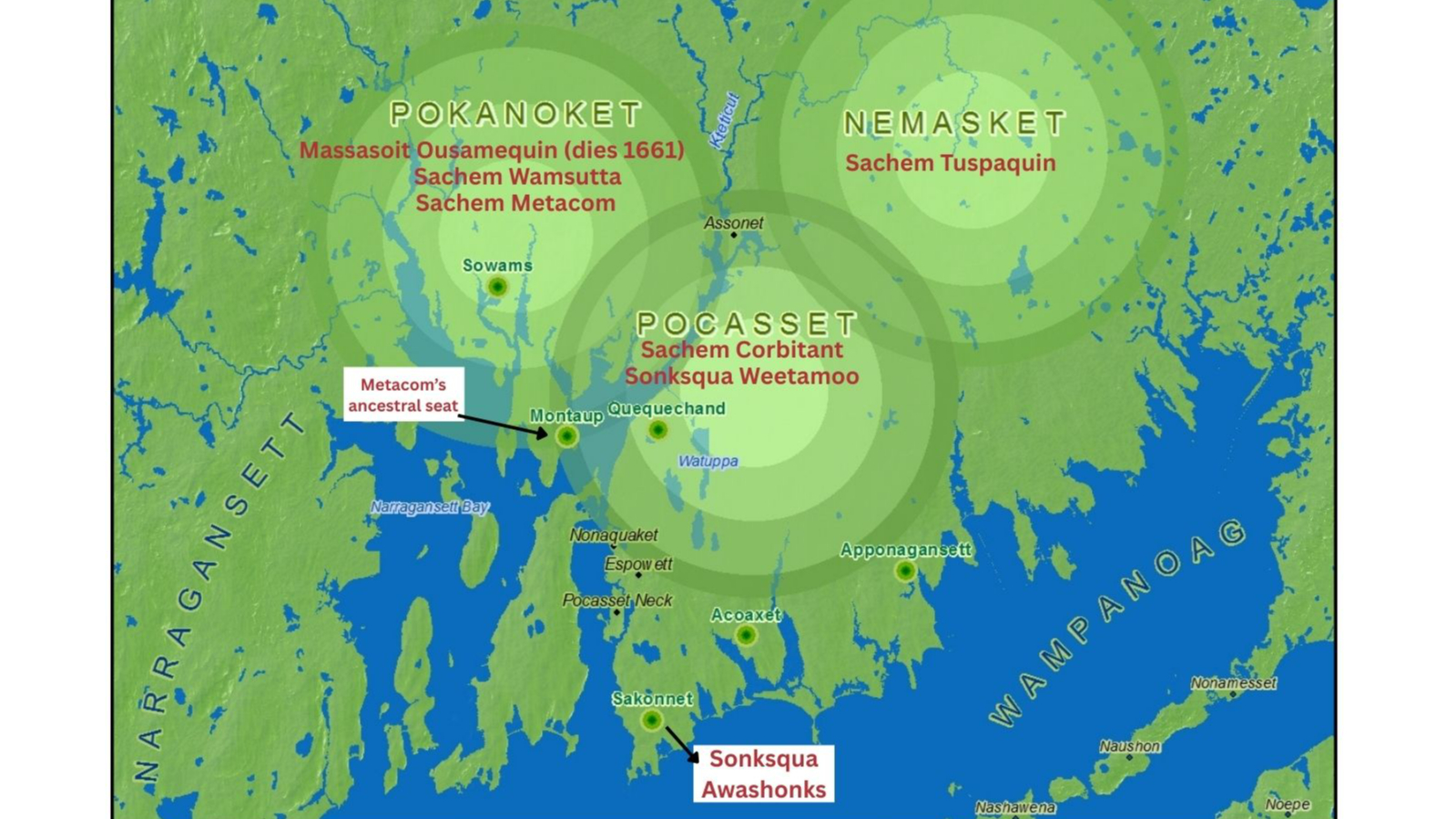
Map of Wampanoag communities and their leaders in mid-1600s
In this map, Wampanoag communities show the dynamic homelands of Wampanoag communities and the men and women who led them in the mid-1600s. The map identifies the homelands of the Pokanoket, led by Massasoit Ousamequin and his sons Wamsutta and Metacom; the Nemasket led by Sachem Tuspaquin, the Pocasset led by Sachem Corbitant and then his daughter Sonksqua Weetamoo, and the Sakonnet, led by Sonksqua Awashonks. During political negotiations and warfare with English colonists from the 1630s-1670s, Wampanoag communities worked to maintain and defend their sovereignty[the power of a people to control its own government].
Citation: Dr. Lisa Brooks, Wampanoag concentric circles ARC_GIS map, Our Beloved Kin: Remapping A New History of King Philip's War (2019). Names of Wampanoag leaders have been added to this map by MHS Education.
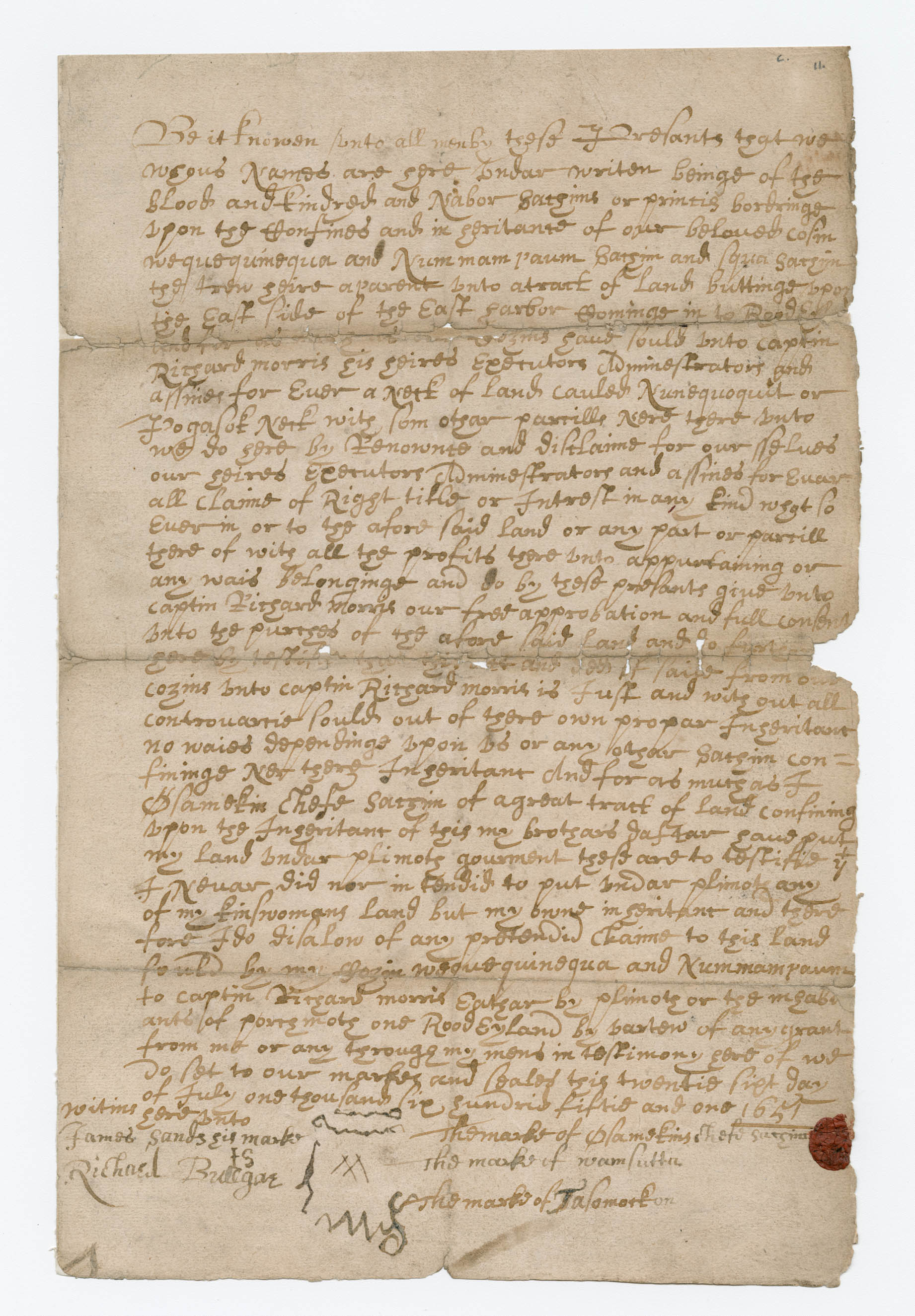
Land deed between Pokanoket Wampanoag and English colonists that acknowledges Weetamoo as the leader of the Pocasset Wampanoag, 1651
Land deeds drafted in English by settler colonists[a population of people that aims to take over the lands of the Indigenous population living there] and Wampanoag leaders who signed them were an early tool of land acquisition by colonists, often under significant pressure by colonial authorities. In many circumstances, these deeds also reflect complex Wampanoag relationships between neighboring kin communities. For example, in this deed acknowledging Pocasset Wampanoag Sonksqua[an Algonquian word for a woman chosen by her community to lead] Nummampaum, later known as Weetamoo, land is exchanged to Richard Morris at a location called Nunequoquit and her sole authority there is stated by Massasoit Ousamequin, Sachem[an Algonquian word for a man chosen by his community to lead] Wamsutta of Pokanoket, and Sachem[an Algonquian word for a man chosen by his community to lead] Tuspaquin of Nemasket.
In the quote excerpted here, Ousamequin clearly states that he cannot grant the English colonists any rights to land in the territories of neighboring Wampanoag communities, such as the homelands of his kinswoman sonksqua Weetamoo and the Pocasset Wampanoag.
Citation: Deed signed by Ousamequin and Wamsutta, 1651, from the Hutchinson-Oliver Papers, Massachusetts Historical Society, www.masshist.org/database/7714
I, Ousamequin, Chief Sachem of a great tract of land confining upon the inheritance of this my brother's daughter have put my land under Plimoth government. These are to testify that I never did nor intended to put under Plimoth any of my kinswoman's land, but [only] my own inheritance, and therefore I do disallow of any pretended claim to this land sold by my Cousin Wequequinequa and [Weetamoo] to Captain Richard Morris
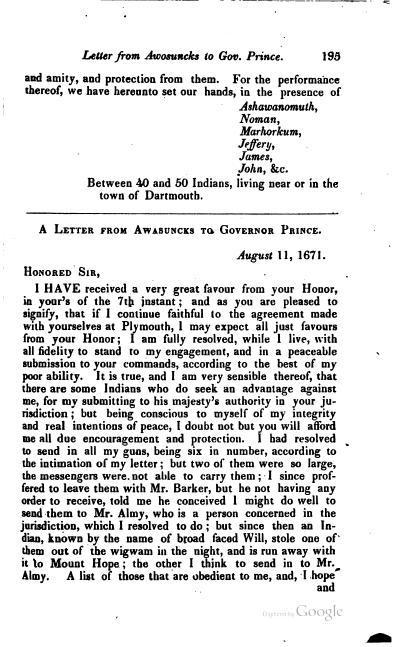
Sonksqua Awashonks writes to Governor Prince, 11 August 1671
In 1671, colonial authorities made significant attempts to limit Indigenous sovereignty in the region, increasing tension between Indigenous communities and English settlers. In July, Plymouth Colony summoned Sonksqua[an Algonquian language term for a woman chosen by her community to lead] Awashonks, leader of the Sakonnet Wampanoag community, alongside other Indigenous leaders, to a meeting under the threat of military force if they did not attend. During the meeting, Awashonks was largely coerced to sign articles of agreement with Plymouth Colony to protect her community in Sakonnet. In this agreement, Awashonks’ community would be forced to turn over arms, surrender ‘troublesome’ Sakonnets to English authorities, and submit to Plymouth’s authority. In September, Plymouth Colony summoned Metacom to an English court in Taunton to answer to rumors that he was raising a force against them. As they had done to Awashonks, colonial authorities forced Metacom into a new treaty that aimed to coerce the Wampanoag into surrendering their arms to English authorities. Despite these agreements, English encroachment into Wampanoag Homelands continued, the Wampanoag did not surrender all of their arms, and tense diplomatic exchanges continued as regional Indigenous leaders pushed back on encroachment, conversion, and other forces of colonization.
Following her summons to Plymouth, Awashonks engaged in correspondence with Plymouth Colony Governor, Thomas Prence. In these letters (dictated by Awashonks but translated and transcribed into English by an interpreter), Awashonks acknowledges English authority in Plymouth colony itself, but not over her own territory. She agrees to engage in diplomatic negotiations and work to keep the peace, but does not claim to have control over all individuals within her community.
Citation: Letter from Awashonks to Governor Prince, 11 August 1671, Collections of the Massachusetts Historical Society, ser. 1, vol. 5, pp. 195-6, (Boston: Printed by Samuel Hall, 1798)
I am fully resolved, while I live, with all fidelity to stand to my engagement, and in a peaceable submission to your commands, according to the best of my poor ability. It is true, and I am very sensible thereof, that there are some Indians who do seek an advantage against me, for my submitting to his majesty's authority in your jurisdiction ; but being conscious to myself of my integrity and real intentions of peace, I doubt not but you will afford me all due encouragement and protection. I had resolved to send in all my guns, being six in number, according to the intimation of my letter; but two of them were so large, the messengers were not able to carry them... but since then an Indian, known by the name of broad faced Will, stole one of them out of the wigwam in the night, and is run away with it to Mount Hope…
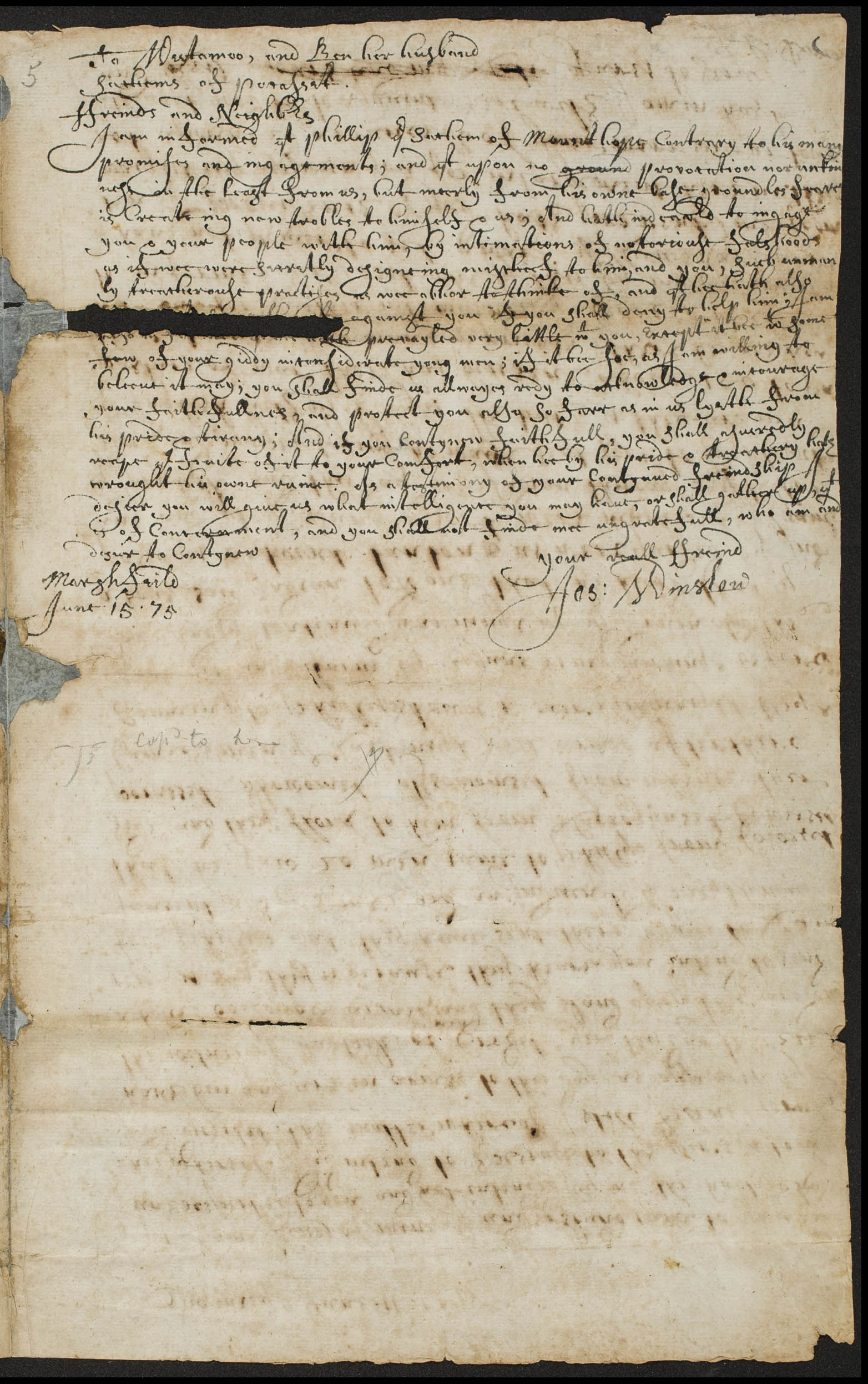
Letter to Weetamoo and her husband Ben, 15 June 1675
Leading up to the outbreak of war, Wampanoag peoples were deeply concerned about settlers continuing to move onto their homelands and the places on which they depended for lifeways, sustenance, spirituality, and more. Wampanoag leaders like Weetamoo and Metacom sought to protect their homelands against further encroachment from settlers in Plymouth and Mass Bay colonies. In an effort to express her concerns, Sonksqua[an Algonquin languege term for a woman chosen by her community to lead] Weetamoo met with Deputy Governor of Rhode Island, John Easton, and he addressed a letter to Plymouth Colony Governor, Josiah Winslow, on May 26, 1675. In that letter, Weetamoo expressed her fear of oppression by Plymouth men and desires to “set the bounds” of her lands at Pocasset to protect them from encroachment. There is no evidence that Josiah Winslow ever directly responded to this letter.
Instead, it would be followed by this letter two months later where Josiah Winslow writes to Weetamoo, Sunksqua of the Pocasset Wampanoag, and her husband in which he implores her community to remain neutral and not support Metacom. Just nine days later, Wampanoag soldiers would attack Swansea, a colonial military post and settlement in Plymouth Colony, marking the start of the War for the Dawnland. In retaliation, Plymouth colonists sent its military to destroy Mount Hope, Metacom’s homelands in Pokanoket (present-day Bristol, RI).
This letter shows historians how Plymouth's leaders attempted to divide and control Indigenous communities and leaders through its communications with them. It also highlights Weetamoo's role as a diplomat and protector of her people.
Citation: Letter (copy) from Josiah Winslow to Weetamoo and Ben her husband, 15 June 1675, From the Winslow family papers II, Massachusetts Historical Society, https://www.masshist.org/database/7489.
I am informed that Phillip, the Sachem of Mount Hope, contrary to his many promises and engagements…is creating new troubles to himself and us; And hath endeavored to engage you and your people with him...if you continue faithful, you shall assuredly reap that fruit of it to your Comfort, when he [Metacom] by his pride and treachery have wrought his own ruin. As a testimony of your continued friendship, I desire you will give us what intelligence you may have, or shall gather up…
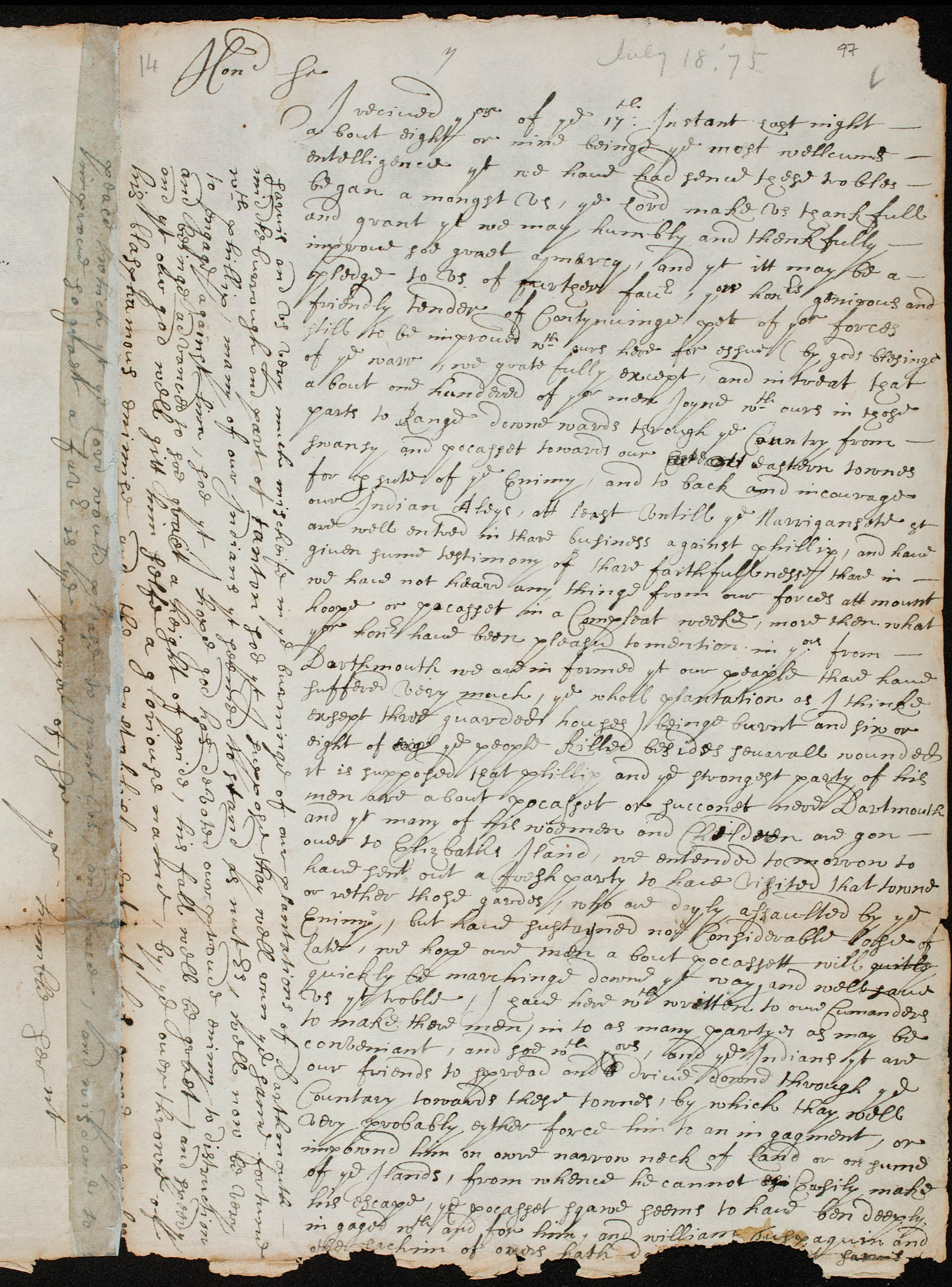
Colonial Governors discuss strength of Indigenous war strategies, 18 July 1675
Indigenous forces saw success in the early part of the war, aided by guerilla tactics and their deep knowledge of the local lands, swamps, and waterways. English forces were initially overwhelmed and hoped to end the hostilities by sending a force directly into Pokanoket to find and capture Metacom. Before Metacom’s people could be ambushed or captured, Weetamoo sheltered his community in the Pocasset swamps, which proved to be an unfamiliar and frustrating battleground for English forces.
In a letter to John Leverett, the Governor of Massachusetts Bay Colony, on July 18, 1675, Plymouth Governor Josiah Winslow acknowledges the strength of Metacom’s strategy and forces, and mentions that Indigenous communities were using the swamps to shelter women and children.
Citation: Letter from Josiah Winslow to John Leverett, 18 July 1675, From the Winslow family papers II, Massachusetts Historical Society, https://www.masshist.org/database/7725.
It is supposed that Phillip and the strongest party of his men are about Pocasset or Sakkonet...and that many of his Women and Children are gone over to Elizabeth’s Island… I have written to our Commanders to make these men into as many parties as may be convenient, and go... down through the Country towards those towns, by which they will very probably either force him [Metacom] to an engagement, or impound him on our narrow neck of Land or on some of the Islands, from whence he cannot easily make his escape. The Pocasset squaw [Weetamoo] seems to have been deeply engaged with and for him and William Tuspaquin [Sachem of Nemasket].
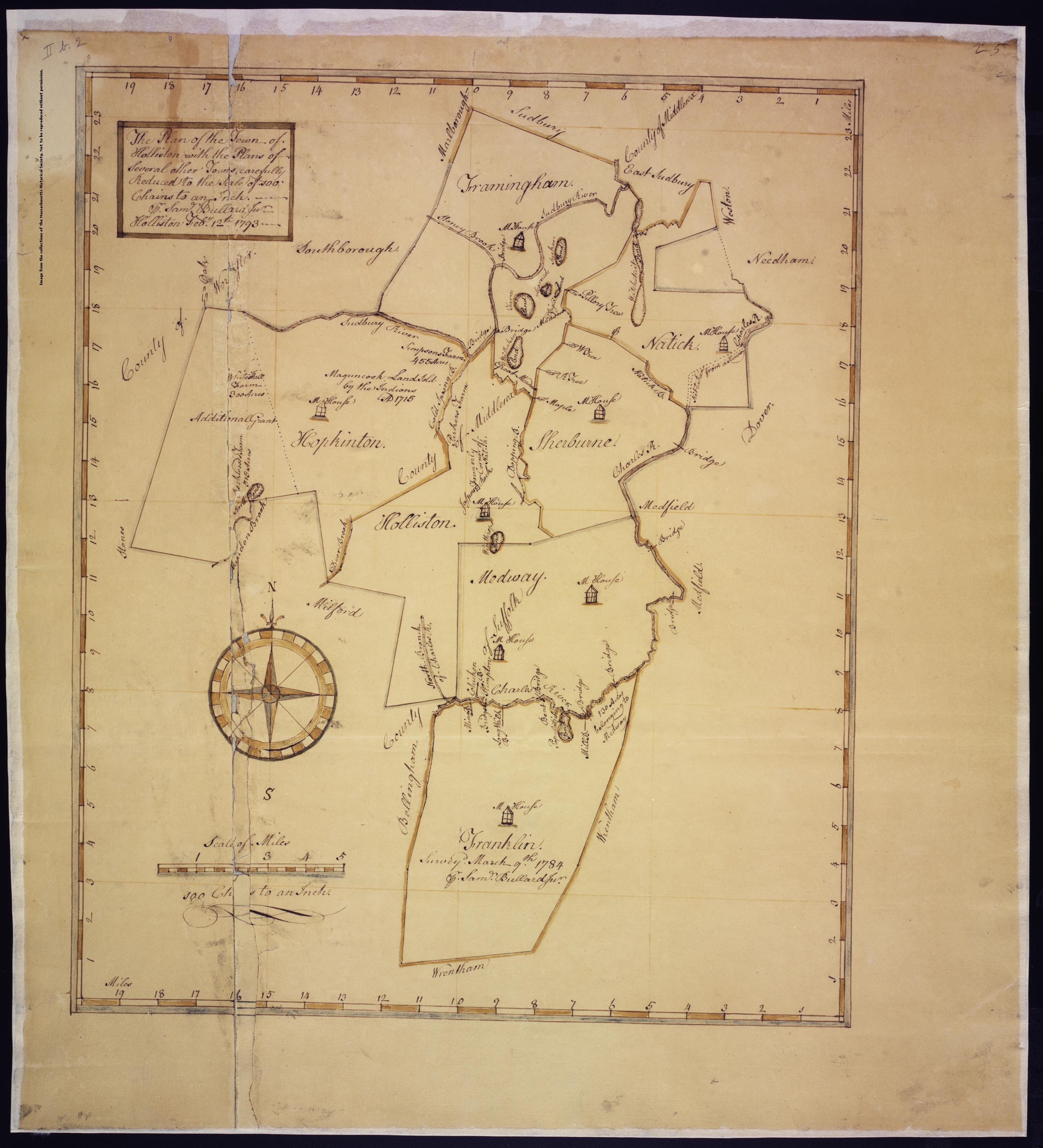
James Wowaus (Nipmuc) leaves a note for settlers on the Medfield bridge, February 1676
In February 1676, several months into the war that now embroiled Wampanoag, Nipmuc, Narragansett, and Wabanaki communities, a note was tacked to a bridge in Medfield, Massachusetts, believed to have been written by James Wowaus. In the map pictured here, the bridge is marked crossing over the Charles River between Medfield and Sherborn.
Known to settlers as James Printer, Wowaus was a Nipmuc man from Hassanamesit. Literate and fluent in Algonquian languages and English, Wowaus possessed a rare skillset. He worked at Harvard College’s printer and set the type for Bibles written in Algonquian languages.
In this note, Wowaus highlights English greed as one of the key reasons for conflict and provides insight into the feelings of many Indigenous people during the War. Later on, Wowaus would serve as a scribe during peace negotiations for Nipmuc people in the spring and would spend his life protecting Nipmuc people and homelands.
Wowaus’ note itself has been lost. The contents of the note, however, were recorded in a letter from the colonist Noah Newman to John Cotton on March 14, 1676.
Map Citation: Manuscript plan of the town of Holliston, 12 February 1793, Pen and ink and watercolor by Samuel Bullard, Massachusetts Historical Society, https://www.masshist.org/database/1710
Quote Citation: Noah Newman to John Cotton, March 14, 1676, Curwen Family Papers, page 2, American Antiquarian Society
a writing was found at the foot of the Bridge with this... Language: ‘Thou Englishmen hath provoked us to anger & wrath & we care not though we have war with thee this 21 years for there are many of us 300 of which hath fought with thee at this time; we have nothing but our lives to lose, but thou hast many fair houses, cattle, & much good thing.'
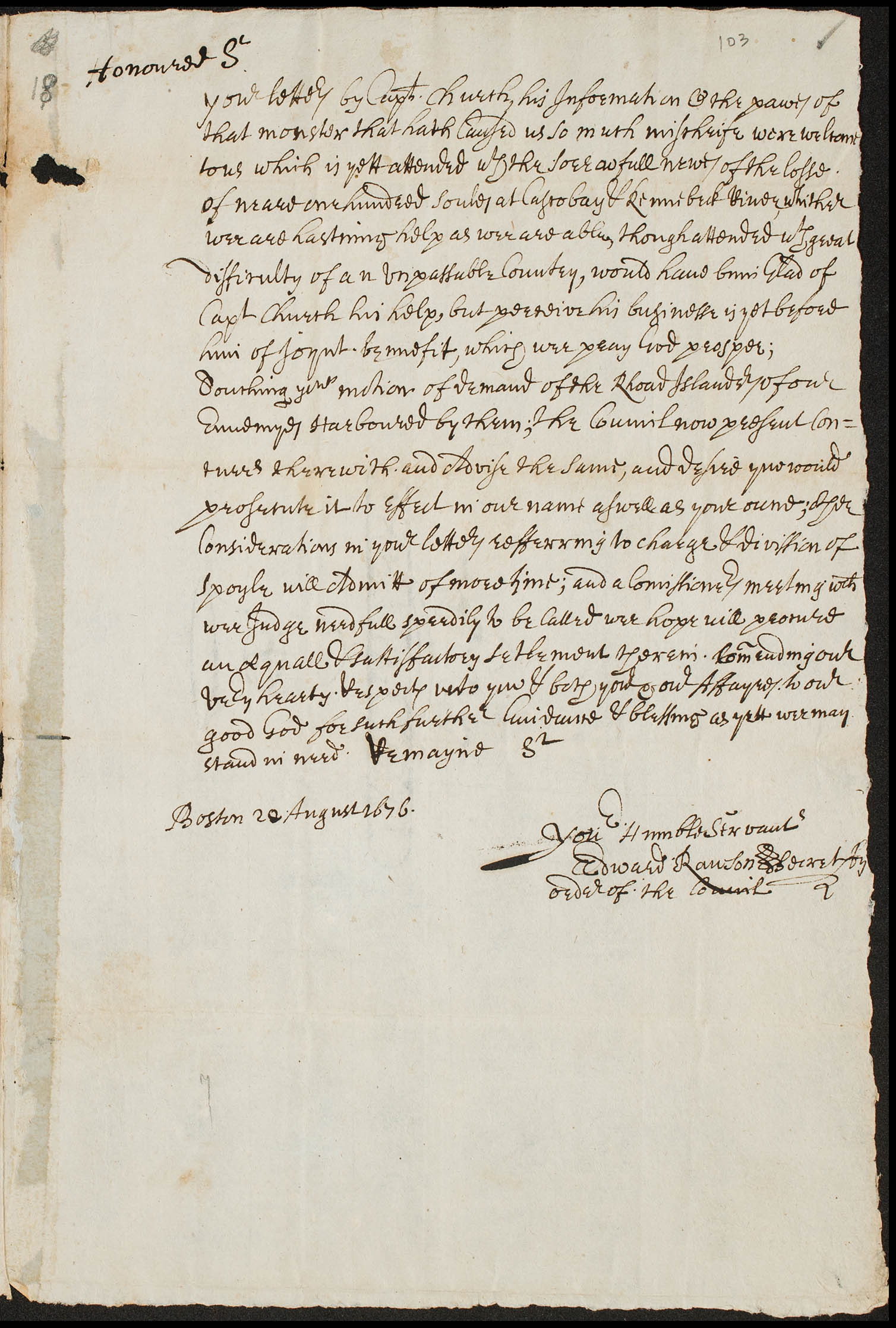
Letter from Edward Rawson to Josiah Winslow on the assassination of Metacom, 28 August 1676
Edward Rawson, a politician and secretary to Governor Leverett of Mass Bay Colony, wrote this letter to Plymouth Governor Josiah Winslow on August 28, 1676. In it, Rawson describes the English pursuit (led by Plimoth militiaman Benjamin Church) and assassination of Metacom in the swamps around his home at Montaup (Mt. Hope). Killing Metacom had been a long-standing goal of colonial forces.
In this letter, Rawson also describes continued fighting elsewhere across the Dawnland[an Indigenous term for understanding the region known commonly as New England], highlighting the multi-faceted nature of this conflict across multiple fronts. On the same day English forces killed Metacom, allied Indigenous forces launched a new series of raids in Wabanaki territory, the northern theater of the war, resulting in the deaths of approximately 100 English settlers.
Citation: Edward Rawson to John Leverett, 28 August 1676, from the Winslow Family Papers II, Massachusetts Historical Society, https://www.masshist.org/database/7726
the paws [pause] of that monster that hath caused us so much mischief were welcome to us which is yet attended wth the soe awfull news of the losses of near one hundred souls at Casco Bay & Kinnibeck…
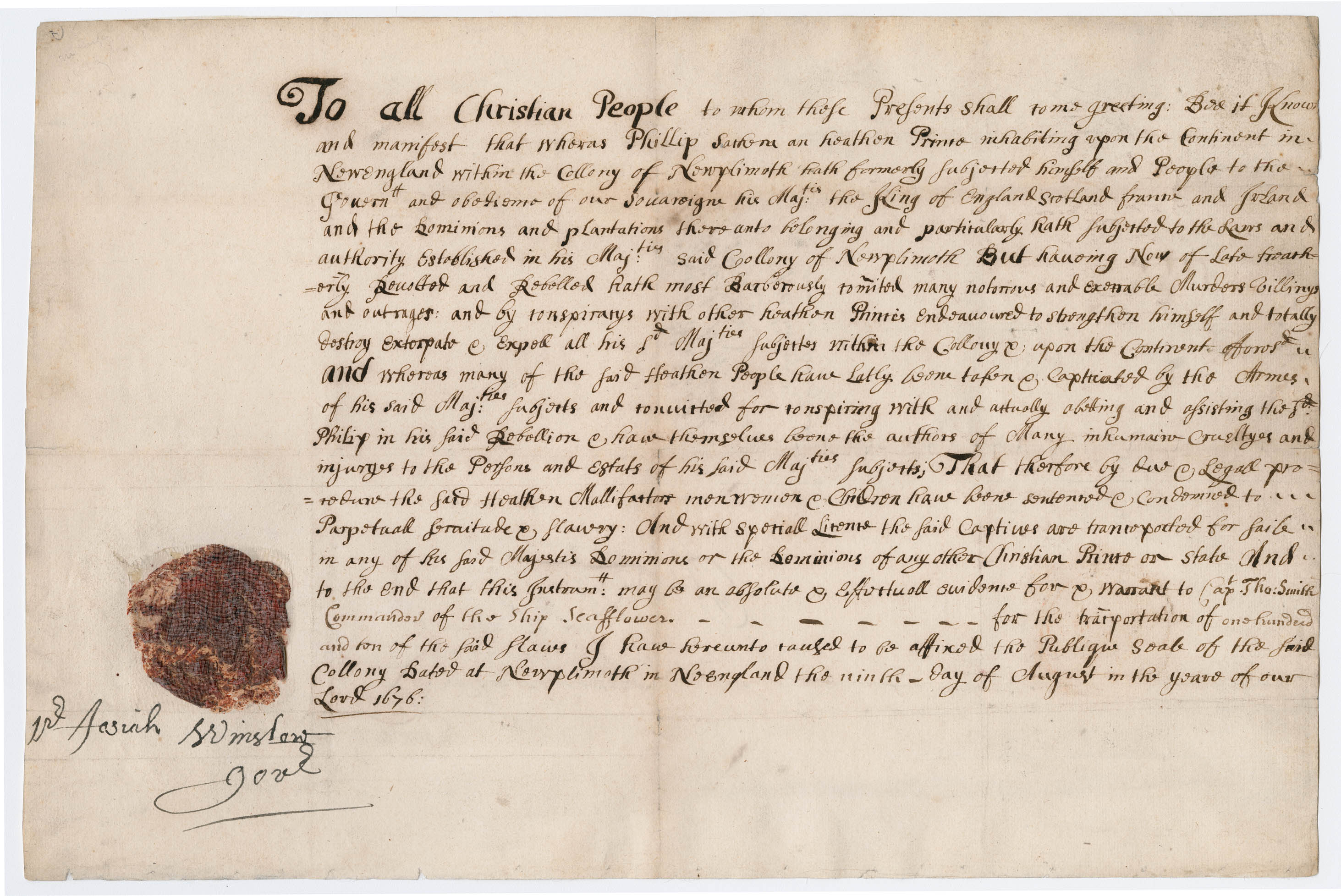
Certificates of enslavement, August and September 1676
Throughout the late 16th and 17th centuries, English settlers enslaved Native peoples in their own households and, particularly in wartime, forcibly removed them from their homelands and sent them to islands in the Caribbean. In many early interactions, Indigenous people were kidnapped, enslaved and sent to Europe to be displayed as curiosities for the public. Later on, Settler colonists used enslavement as a tactic in both the Pequot War of the 1630s and during the War for the Dawnland[an Indigenous term for understanding the region known commonly as New England]. Colonial authorities across New England used enslavement of Native people as punishment for crimes committed, debts held, or for resisting colonial authority. Under the threat of enslavement, Wampanoag and Nipmuc warriors fought for sovereignty[the power of a people to control its own government] over their lands and for their freedom to remain on those lands.
In August and September 1676 the Governors of the Plymouth and Mass Bay colonies signed certificates to enslave a total of 180 Wampanoag and Nipmuc people and forcibly transport them to the Caribbean on the ship Seaflower, captained by Thomas Smith. The certificates use the language of Christianity and legal procedure to justify colonists’ enslavement and removal of men, women, and children, condemning these individuals to be sold to “a Christian Prince or state,” meaning another European power with colonies in the Atlantic world. These two documents are examples of an extensive practice of using enslavement as a form of punishment.
These documents reveal settler paranoia and fear over united Native resistance to English violence and land encroachment. The certificates also show that, as settlers were enslaving people of African descent to build wealth from the land, they also enslaved Indigenous people to remove them from the land they wanted for themselves.
Citation: Certificate from Josiah Winslow, Governor of the Colony of Plymouth issued to Thomas Smith, 9 August 1676, Massachusetts, Historical Society, https://www.masshist.org/database/3527
Phillip, sachem and heathen Prince…having...Rousted and Rebelled; hath most Barbarously committed many nefarious and execrable Murders, villainies, and outrages: and by conspiracies with other heathen Princes endeavored to strengthen himself and totally destroy, extirpate & expel his said Majesty’s subjects within the Colony and upon the Continent aforesaid; and, whereas, many of the said Heathen People have lately been taken and Captivated by the Armies of his said Majesty’s subjects and committed for conspiring with and actually abetting and assisting the said Philip in his said Rebellion and have themselves been the authors of Many inhumane cruelties and injuries to the Persons and estate of his said Majesty’s subjects; that therefore by due and Legal procedure the said Heathen Malefactors – men, women and children – have been sentenced and condemned to Perpetual servitude and slavery…
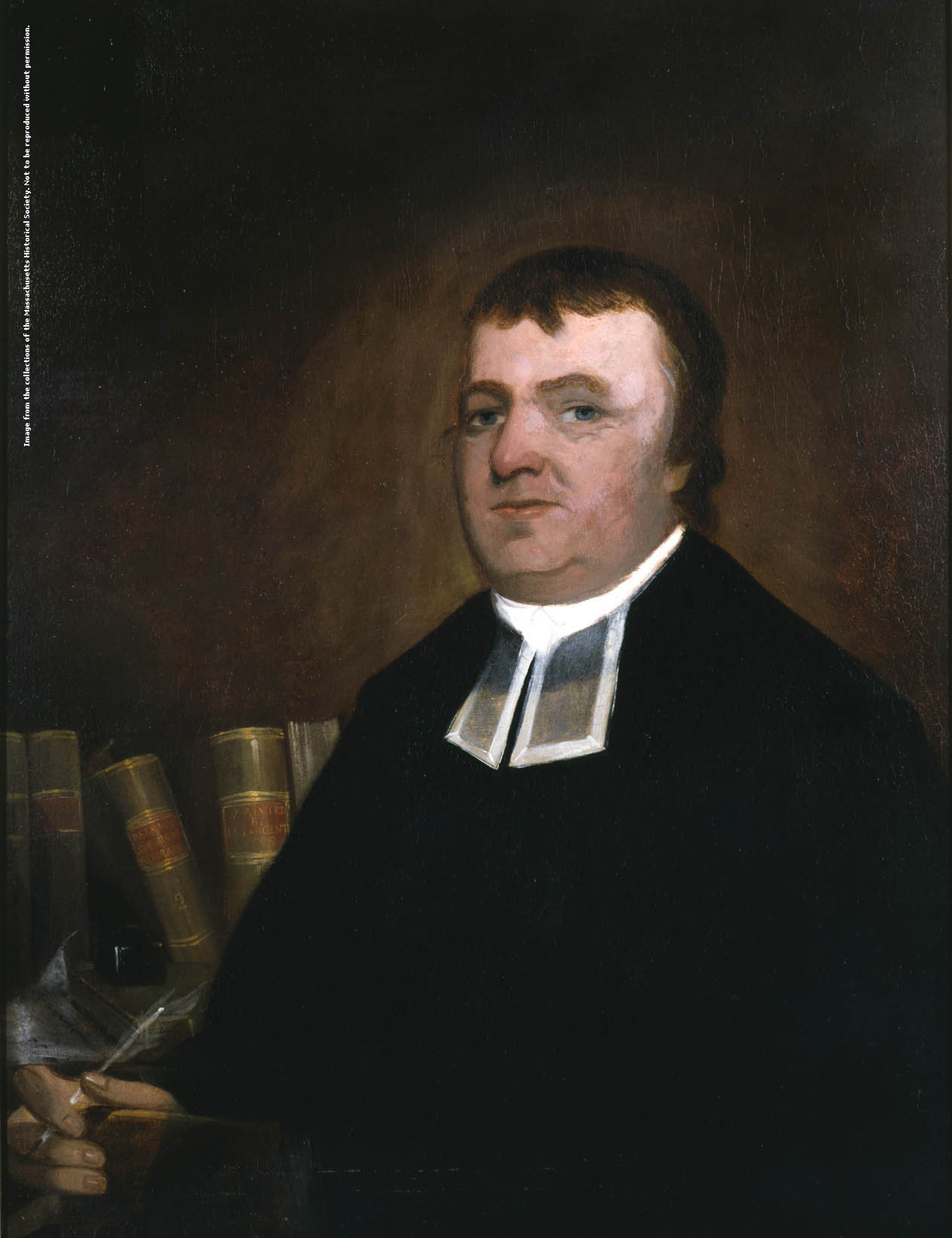
1678 Treaty of Casco Bay as described by the colonist Jeremy Belknap
The 1678 Treaty of Casco Bay ended the War for the Dawnland[an Indigenous term for understanding the region known commonly as New England] in the northern theater after much of the southern theater concluded in the fall of 1676. The original treaty has been lost, but settler historian and minister Jeremy Belknap wrote about it in Volume 1 of his History of New Hampshire (1792). The treaty describes an agreement between the Wabanaki and settler inhabitants in New Hampshire colony and the province of Maine in which English settlers agreed to pay Wabanaki leaders “a peck of corn” for their continuing to live on Wabanaki lands. The wealthiest among the settlers owed more corn than the others. The Treaty of Casco Bay emphasizes settler responsibilities to Indigenous people and their lands and waters. Belknap’s description emphasizes that this treaty was aimed at ending the war between Native and settler communities across New England. Despite this, for many of those communities, the conflict was far from over.
While Indigenous communities endured significant land losses during the War for the Dawnland[an Indigenous term for understanding the region known commonly as New England], the Treaty of Casco Bay is an example of ways in which Native resistance disrupted English power structures and led to English recognition of Native jurisdiction over their own lands. Despite this, English parties refused to abide by the treaty and began further harmful actions that would lead to future conflict and failed negotiations around a second treaty in 1703.
Image Citation: Jeremy Belknap Portrait, oil on canvas by Henry Sargent, 1798, Massachusetts Historical Society, www.masshist.org/database/159
Quote citation: The History of New Hampshire / By Jeremy Belknap, Volume 1,1792. [HathiTrust Digital Library]
It was stipulated in the treaty, that the inhabitants should return to their deserted settlements, on condition of paying one peck of corn annually for each family, by way of acknowledgment to the Indians for their possession of their lands, and one bushel for Major Pendleton, who was a great proprietor. Thus an end was put to a tedious and distressing war, which had subsisted three years.
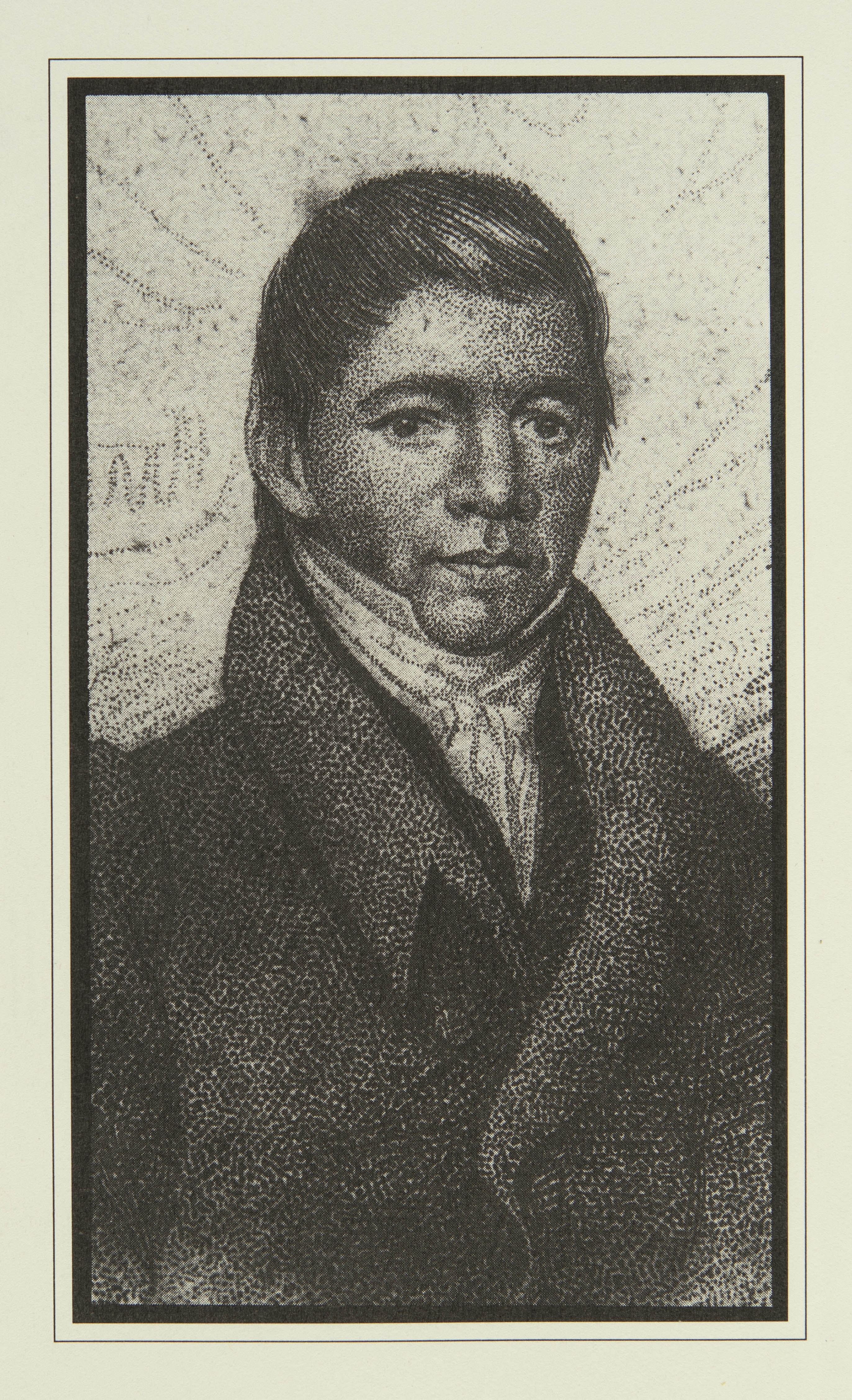
Pequot historian William Apess describes Metacom's Legacy, 1836
Written by Pequot minister, historian and activist William Apess in 1836, The Eulogy on King Philip is an example of how Indigenous people memorialized the War for the Dawnland[an Indigenous term for understanding the region known commonly as New England] and connected it to current times. In this speech, William Apess emphasizes the role of Native people as survivors and fighters rather than passive victims of colonization. He condemns the Pilgrims as hypocritical Christians who robbed graves and sought to unseat Metacom’s power. Apess closes by tying the history of Metacom to the larger history of enslavement in the Americas, decrying the state’s treatment of non-white peoples. Apess' work stands in contrast to the work of many settler narratives and acts as a form of resistance within itself. Throughout his speech, Apess describes Metacom’s enduring legacies of settler violence and Wampanoag resistance to it – in 1676 and in 1836. His work continues to resonate today, in 2026.
Image Citation: Barry O'Connell, Editor. On Our Own Ground: The Complete Writings of William Apess, a Pequot. (The University of Massachusetts Press, 1992.) The image comes from the image of Apess found in the second edition of his autobiography, A Son of the Forest, published in 1831.
Quote Citation: Eulogy on King Philip : as pronounced at the Odeon, in Federal Street, Boston / by the Rev. William Apes. (Boston : The author, 1836.)
How deep then was the thought of Philip, when he could look from Maine to Georgia, and from the ocean to the lakes, and view with one look all his brethren withering before the more enlightened to come ; and how true his prophesy, that the white people would not only cut down their groves, but would enslave them. Had the inspiration of Isaiah been there, he could not have been more correct. Our groves and hunting grounds are gone, our dead are dug up, our council-fires are put out, and a foundation was laid in the first Legislature, to enslave our people, by taking from them all rights which has been strictly adhered to ever since. Look at the disgraceful laws, disfranchising us as citizens. Look at the treaties made by Congress, all broken. Look at the deep-rooted plan laid, when a territory becomes a State, that after so many years, the laws shall be extended over the Indians that live within their boundaries.
Objectives for this Source Set
By reading the historical context overview, analyzing the primary sources, and doing the activities in this source set, students will be able to:
- Gain an understanding of and practice using Indigenous vocabulary terms that appear in the War for the Dawnland source set.
- Develop an understanding of the causes and consequences of the War for the Dawnland.
- Analyze primary source documents and engage in dialogue about them with their peers.
- Use evidence to make a claim about Indigenous and colonist relations in the Dawnland (New England) from the 1660s-1670s.
Background Reading: Causes and Consequences of the War for the Dawnland
Arrival and Disruption: Early Relations and Colonial Expansion in the Dawnland (1620s-1630s)
For many thousands of years, Indigenous Nations such as the Wampanoag, Narragansett, Nipmuc, and Abenaki have called the Dawnland (New England) home. When English colonizers arrived on these shores in 1620, a period of disruption to Indigenous lifeways began. The English established their first permanent settler colony in the Dawnland in 1620 at the Wampanoag village of Patuxet. It was settled after an event called the Great Dying. During that time, it is believed that upwards of 70-90% of the Wampanoag population was killed by a disease outbreak.
By September 1621, the English settlers at Plymouth Colony and Sachems from ten Wampanoag communities, led by the Sachem Ousamequin, had agreed to a treaty. However, despite promises to protect and respect each other, this treaty was broken many times. By the 1630s, Wampanoag, Pequot and Narragansett homelands were surrounded by the colonies of Plymouth, Mass Bay, Connecticut and Rhode Island. In 1637, there was an armed conflict called the Pequot Massacre. New England colonies worked together and killed and enslaved many Pequot people. The English colonists sent many of the enslaved Pequots to the Caribbean. The colonists would use these same tactics in the War for the Dawnland in the 1670s.
Shifting Relations: Missionary Efforts, Encroachment, and Indigenous Responses (1640s-1650s)
After the Pequot Massacre, many Indigenous communities were outnumbered by colonists for the first time. Between 1630-1640, 20,000 English colonists had migrated to Mass Bay colony alone! As the population of the English colonies grew, colonial forces attempted to take more land and limit Indigenous sovereignty. The English wanted to take more land and have authority over Indigenous people. Indigenous communities resisted in many ways. First, English settlers attempted to force Indigenous leaders to express loyalty to the English Crown. Indigenous communities often refused to declare loyalty to the English King. They were loyal to their own leaders. Secondly, many English settlers tried to convert Indigenous people to Christianity. They formed Praying Towns, which were communities reserved only for Indigenous people who became Christian. Praying Towns caused tension between Indigenous people who converted and those who did not. Third, English settlers pressured Indigenous leaders to sell their lands and sign documents called land deeds. Many of these deeds feature the Sunksqua Weetamoo, female leader of the Pocasset Wampanoag community. In a 1651 land deed [Source 1], male sachems, including Ousamequin, acknowledge Weetamoo’s authority and tell English settlers that they cannot sell lands that are part of her community. At every turn, Wampanoag communities found ways to resist the English and claim their own authority over their lands and people.
Irreconcilable Differences: Towards English Desires of Domination (1660s-1671)
In 1661, the Wampanoag Sachem named Ousamequin died. Throughout his life, Ousamequin had agreed to sell some land to colonists to try and prevent conflict and protect his people. With his journey into the next life, Ousamequin’s son Wamsutta became Sachem. When he died, Metacom became sachem.
When Metacom became Sachem both the Wampanoag and the English settlers were suspicious of each other. The Wampanoag feared English colonists would continue to limit their rights and take their land. The English feared Wampanoag communities would work with other Indigenous communities to attack them. Metacom’s goal was to protect Wampanoag lands and lifeways.
In 1671, the Governor of Plymouth Colony brought two Wampanoag leaders: Sunksqua Awashonks, leader of the Sakonnet Wampanoag, and Metacom, Sachem of the Ponkapoag Wampanoag, to two separate meetings. The English made the two leaders sign treaties saying their Wampanoag communities would give their guns to the English and submit to English laws. In turn, the English promised not to take any new land. Awashonks and Metacom both signed the treaties in an effort to protect their homelands and to prevent conflict. (Source 2) This agreement mostly failed. English colonists continued moving onto Wampanoag homelands. Wampanoag peoples refused to turn in all of their guns.
By 1675, relationships between the Wampanoag and the English were tense. Wampanoag sovereignty and thousands of years of lifeways were under threat. The introduction of English domesticated animals and farming practices harmed traditional foodways and land practices. Additionally, English colonial authorities grew even more fearful of a possible attack against them.
Sparking the Kindling: The Death and Trial of John Sassamon (January - June 1675)
A final event that led to the War for the Dawnland occurred in January 1675. An Indigenous man known to the colonists as John Sassamon, was found dead at a pond. Sassamon lived in an Indigenous community and had converted to Christianity. He lived “between both worlds” of Indigenous and English cultures. He spoke Algonquin languages and English. He worked as an interpreter and translator for Metacom and for English missionaries. He was killed on Wampanoag homelands. Officials in Plymouth Colony arrested three Wampanoag men and put them on trial for Sassamon’s murder. It was the first time English law was applied to a suspected crime that took place on Indigenous lands. The Wampanoag were angry that the English did not respect Wampanoag authority. Metacom marched a large force of Wampanoag men to the area in an effort to display his strength. In the end, the three Wampanoag men accused of the crime – Tobias, his son Wampapaquan, and Mattashunnamo – denied the charges, but the jury of colonists found them guilty and sentenced them to death by hanging. Metacom’s anger grew.
A Crashing Wave: War Begins (June - December 1675)
Metacom and Weetamoo Work Together
After Sassamon’s trial, colonial authorities in Plymouth grew concerned Metacom was preparing for war by gathering warriors at Montaup (Mt. Hope) in Pokanoket, present-day Rhode Island, the center of his homelands. Rhode Island officials traveled to Montaup in June 1675 to meet with Metacom and his trusted advisors. Easton hoped to use diplomacy to prevent conflict. At the meeting, Metacom presented a list of Wampanoag grievances. The Wampanoag were angry that the English continued to: move onto Wampanoag land; destroy Wampanoag crops and traditional foodways with their livestock; treat Wampanoag people unfairly in English courts; force Wampanoag people to convert to Christianity; sell liquor to Wampanoag communities; and fail to respect Wampanoag authority. This meeting shows that diplomacy was not solving problems between the Wampanoag and the colonists. For many within the Indigenous communities, the presence of thousands of English settlers posed a threat to thousands of years of continued existence.
Around the time that Metacom met with Rhode Island officials, Josiah Winslow, the Governor of Plymouth colony, wrote a letter to Weetmaoo and her husband Ben (Source 3). Fearing war could be near, In his letter, Winslow calls Weetamoo and Ben his “friends and neighbors”. He urges Weetamoo not to support Metacom and to provide him with any information her community might have about Metcom’s plans. Despite signing as “your reall friend”, Josiah Winslow’s letter can be seen as an attempt to divide Wampanoag communities from one another. It was also a threat to treat Weetamoo as an enemy if she did not help Plymouth Colony.
Days after this letter was written, the War for the Dawnland began in Swansea (part of Plymouth Colony) on June 20, 1675 when a group of Pokanoket Wampanoag men raided and destroyed several houses. Historians do not know if Metacom authorized the attack, but colonists viewed him as the leader. In the following weeks, Plymouth and Massachusetts Bay colonies sent their own forces into the conflict. The colonists hoped to end the conflict quickly by capturing Metacom. However, Weetamoo protected Metacom and his warriors in the Pocasset swamps. The swamps were an unfamiliar and frustrating battleground for English forces. Despite Plymouth and Massachusetts Bay colonies working together, they did not find Metacom. In the early part of the war, Metacom and Weetamoo used their knowledge of the swamps as a successful strategy. In a letter from Plymouth Governor Josiah Winslow to Mass Bay Governor John Leverett, on July 18, 1675, Winslow acknowledges the strength of Metacom’s forces and mentions that he and Weetamoo were working together to protect their communities (Source 4).
Narragansett Communities Suffer Loss
In the following days and weeks, Narragansett, Nipmuc, and Wabanaki communities would engage in their own conflicts against colonists in their homelands, further expanding the war. Early in the war, Indigenous communities were successful. In response, the colonies of Plymouth, Massachusetts Bay, New Haven, and Connecticut, and with some aid from Rhode Island, united together against the Indigenous nations. However, in the first winter of the war, Indigenous communities began to struggle.
The Narragansett had signed a treaty of neutrality with Massachusetts Bay Colony. That means they had said they would not take part in the war. For additional protection, Narragansett communities Despite signing a treaty of neutrality with Massachusetts Bay Colony in October, the Narragansett left their homes and traveled to a large fort in the Great Swamp near present-day Kingston, Rhode Island. The following month, Josiah Winslow led colonial forces into Narragansett Homelands. The militia burned abandoned Narragansett villages so that the Narragansett would have no villages to return to after the conflict. After a failed attempt to negotiate peace, Narragansett warriors attacked a local blockhouse. In response, Massachusetts Bay, Plymouth, and Connecticut colonies attacked the Narragansett settlement at the fort. After a fierce fight, colonial forces burned down the settlement while many elders, women, children, and non-combatants were still inside. This was a strategy colonial forces had used during the Pequot Massacre in the 1630s. In the conclusion of the battle, most of the Narragansett winter food stores were destroyed and those who survived fled into the swamps. This dealt a major blow to Narragansett strength, but leaders prepared to launch new campaigns in the spring.
Freedom, Servitude, or Death: Difficult Choices (Winter 1676)
Throughout the war, both Indigenous and English communities became suspicious of the Praying Towns where Indigenous people who had converted to Christianity lived. During the War for the Dawnland, some Praying Towns sided with the English colonists, but officials did not trust them. Massachusetts Bay Colony ordered Christianized Natives to be interned at Deer Island, a small island in Boston Harbor. Held in jail in bad conditions, many people died during their internment. Colonial officials asked some of them to work as spies during the war. This shows that colonial officials often depended on Indigenous people for their knowledge of their communities and homelands, even if they did not fully trust them.
Although some helped the English, many Indigenous people in Praying Towns resisted colonial authority during the war. For example, a Nipmuc man by the name of James Wowaus, or James Printer, attended Harvard Indian College in Cambridge and worked with both Metacom and English missionaries as an interpreter. Wowaus could read and write in Algonquian languages and English. During the war, he chose to support Metacom. In February 1676, inter-tribal Indigenous forces attacked Medfield (in present-day Massachusetts). Wowaus is believed to be responsible for tacking a note to a bridge explaining that Indigenous people had been pushed to fight in the war because they had lost so much to the settlers, stating that “we have nothing but our lives to lose but you have many fair houses, cattle, and much good things.” (Source 5).
Another Nipmuc man named Quonopohit had lived in the praying town of Natick prior to the war. During the war, Quonopohit is believed to have asked other Indigenous men why they continued to fight. The younger men responded, “Why shall we have peace to be made slaves, & either be killed or sent away to sea to Barbados”. That is, Indigenous men fought in the War for the Dawnland even after they had begun to lose because if they did not fight they could lose more land or be enslaved.
These men’s fears proved to be well-founded. During winter and early spring 1676, Indigenous communities had to stretch their food reserves and keep moving to avoid united colonial forces. This prevented them from planting crops for spring. At the same time, some Indigenous leaders were killed. In March 1676, Connecticut forces killed Canonchet, a Narragansett Sachem. His head was sent to the colonial leaders as a trophy. Then, in July 1676, Narragansett Sunksqua Quaiapin returned to her homelands with other community members to retrieve corn to plant. Colonial forces intercepted them and killed many. They sold survivors into slavery. These two examples highlight two main colonial war strategies: large scale massacres of non-combatant Indigenous groups and the legal use of enslavement as punishment. Despite their losses, Narragansett and Niantic forces continued to fight.
The winter months were also hard for Metacom. He set up a camp in Schaghticoke, New York in an effort to enlist the support of Kanienʼkehá:ka (Mohawk) communities, members of the Haudenasaunee Confederacy, in the conflict. However, his efforts were not successful. The Kanienʼkehá:ka had already established relations with French, Dutch, and English parties entering their traditional homelands and did not always have good relations with Algonquian speaking people, like the Wampanoag. Armed conflict between the Mohawk and Wampanoag weakened Metacom’s forces.
Terror and Destruction: The Deaths of Weetamoo and Metacom (Spring and Summer 1676)
Upon Metacom’s return to the Dawnland, his forces launched a series of attacks. A victory in Sudbury in April 1676, however, would prove to be the last major Indigenous victory in the southern Dawnland region. By July, some of Metacom’s allies had begun to surrender or were turned over to English forces. In August, colonial forces led by Captain Benjamin Church continued their raids in search of Metacom. During these raids, many women and children were captured, including Wootonekanuske, the wife of Metacom and sister of Weetamoo, alongside their nine-year-old son. After much debate, colonial leaders decided to sell Metacom’s family into slavery.
Weetamoo, one of Metacom’s most important and powerful allies, wanted to return to her Pocasset homelands with her people. This was dangerous because the English had developed strategies to fight in swamps. Before they made it to Pocasset, Weetamoo and her community were ambushed and most of her forces were killed. In her escape across the Taunton River, it is believed Weetamoo drowned. After Weetamoo’s death, Metacom decided to return to Montaup (Mt. Hope). Soon after, Church’s forces found Metacom in the swamps surrounding Montaup. He was shot and killed by John Alderman, a Christian Wampanoag man who had previously fought on Metacom’s side. After so many years spent trying to control him, colonial forces had finally killed the man they blamed for the war (Source 6). Like other Indigenous leaders killed during the war, Metacom’s body was treated as both a trophy and warning sign. He was ultimately beheaded and colonial authorities displayed his head in Plymouth Colony for twenty years.
In the weeks following Metacom’s assassination, the War for the Dawnland in the southern theater (Massachusetts, Connecticut and Rhode Island) came to an end. Colonial forces pursued, captured and punished many of the remaining Indigenous leaders and communities. Metacom’s remaining allies attempted to continue their fight, but were ultimately forced to surrender. Many survivors were punished. They lost their lands or were enslaved. Individuals identified as allies of Metacom – even children – were sentenced to "perpetual servitude and enslavement”, and were sold into slavery and transported to the Caribbean. For example, a certificate signed by Mass Bay Gov. Josiah Winslow on August 9, 1676 sold 110 Indigenous men, women, and children into slavery. (Source 7) During colonial raids, Benjamin Church claimed symbols of Metacom’s sachemship, including his wampum belts, red cloth, and more, as trophies of war. To this day, the Wampanoag Nation continues to search for the belongings taken from Metacom upon his death.
Cataclysmic Conclusions: The End of the War (1676-1678)
While the war in the southern Dawnland had ended, the northern theater raged on. This area of the war had highlighted long standing tensions between Wabanaki communities and English settlers in New Hampshire and Maine. In 1675, English settlers had marched up the Kennebec River in Maine following the attacks in Swansea, Massachusetts and demanded that Wabanaki communities turn over their weapons. In response, Wabanaki warriors began attacking English trading posts, largely under the leadership of Abenaki Sagamore Mog and Penobscot Sagamore Madockawando. The Wabanaki took control of waterways and destroyed the colonists’ fishing economy. Fighting reached a stalemate and the Wabanaki Confederacy sued for peace. Signed in 1678, The Treaty of Casco Bay ended the War for the Dawnland (Source 8). The treaty called for all captives to be returned without ransom and recognized English property rights in Wabanaki Homelands. However, the treaty required the colonists to pay one peck of corn each year for each family settled on Wabanaki land. Ultimately, peace did not last. Conflicts broke out during the 1700s as English colonists expanded their lands, disrespected Indigenous sovereignty, and worked to end French influence in the region.
Lasting Impacts of the War
The War for the Dawnland had profound and lasting impacts on Indigenous communities across the Dawnland. It is estimated that between 40% - 50% of the Indigenous population in the region lost their lives during the conflict, compared to about 5% of the colonial population. When the English arrived on Wampanoag homelands in 1620, there were more than 70 Wampanoag communities. By the end of the War for the Dawnland in the 1670s, only about 12 Wampanoag communities remained. With the war brought to an end, the victorious settlers chose to enslave and dominate Indigenous communities instead of seeking a relationship based on diplomacy and shared sovereignty. From roughly 1694 to 1757, New England colonies issued a series of scalping bounties, offering rewards for colonists who killed Indigenous people, with the goal of reducing the Indigenous population, particularly those who had not converted to Christianity. This is perhaps most evident in one particular bounty, Massachusetts Governor Spencer Phip’s proclamation of 1755, which explicitly targeted Penobscot men, women, and children.
During the Revolutionary War, which began in 1775, some Wampanoag men fought alongside the Patriots. However, many never received pensions, and relations between Tribes and the settlers hardly improved. Throughout the coming decades, Wampanoag communities living in the United States continued to see their rights limited. Despite this, many smaller communities merged into larger ones over time; today, Wampanoag communities in Mashpee and Gay Head continue to ensure their survivance.
Memory and Endurance: Recollections of Metacom and the Continuance of Wampanoag People
Indigenous communities have continued in the Dawnland despite so many efforts to remove us from our homelands. However, many of Metacom’s fears for the Indigenous people of the region came true. Even though the War for the Dawnland remains in the past, it still ripples out to today and has profound impacts on our communities, with many of us fighting to be visible and work towards truth and reconciliation efforts. It is common to encounter people across the New England region who firmly believe that there are no Indigenous people here anymore, and that we disappeared with the war. Many histories of the war – from the 1670s until today – have been written from the perspective of settler colonists. This has impacted the way the public has understood the war.
In the 1800s, with the invasion of Indigenous Homelands out west on the Great Plains, the United States began to think fondly on the era often called the colonial period. Americans began to tell stories about “good Indians” like Tisuantum (Squanto) who they described as helping the colonists. In contrast, American writers described Metacom as an example of a “bad Indian,” who fought against colonists’ interests. Today, there are statues of Squanto in Massachusetts. There are not any statues for Metacom.
In 1833, the Wampanoag community engaged in an act of protest called the Woodlot Revolt. This revolt pushed back on Massachusetts' government control over trees and wood on the Mashpee Wampanoag reservation. Three years later, William Apess, a Pequot man and minister, sought to honor the 160-year anniversary of Metacom’s death from an Indigenous perspective. In a speech in Boston on January 26, 1836, Apess delivered what he titled the “Eulogy on King Philip” (Source 9). In this speech, Apess celebrated Metacom and called for justice for Indigenous peoples. Apess told his audience that Metacom had defended his people and homelands.
Today, Wampanoag knowledge keepers continue to carry and transfer the knowledge and stories associated with the events our ancestors experienced in the past. We continue to honor Metacom and his memory, annually holding a Metacom Day every August 12th as a form of memory and ceremony. The injustices of those events that occurred more than 350 years ago remain and continue to impact the Wampanoag Nation. Despite this and all efforts to remove us from our homelands, we remain and always will.
Close Reading Questions for the Primary Sources in this Set
Source 1: Map of 17th century Wampanoag communities and their leaders (created 2019)
- To get your bearings, Noepe in the bottom right-hand corner is the Indigenous place name for Martha’s Vineyard. Look at a map (e.g., Google maps) to see what communities are presently located on the Wampanoag homelands pictured in this map.
- The concentric circles represent the idea that Wampanoag communities did not stay in one set place year round. What does this map suggest about the ways in which Wampanoag peoples used the land in the mid-1600s?
Source 2: Land deed between Pokanoket Wampanoag and English colonists that acknowledges Weetamoo as the leader of the Pocasset Wampanoag, 1651
- What strategies did Ousemequin use to govern relations between Wampanoag communities and Plymouth colony? What evidence do you have for that in the text?
- In what ways does Ousemequin acknowledge the authority of Weetamoo? What does this tell you about relationships between different Wampanoag communities?
- What do you think the phrase “pretended claim” means?
- From this document, how do you think English settlers thought about land deeds with the Wampanoag?
Source 3: Sonksqua Awashonks writes a letter to Governor Prince, 11 August 1671
- Worried about the possibility of armed conflict with Wampanoag communities, Plymouth sought to exert control over leaders like Awashonks and Metacom by demanding their people turn over all their guns for a period of time. How might this impact Wampanoag communities? And how did the English justify their own actions?
- In this excerpt, what obstacles to turning in all guns does Awashonks cite? What does this tell you about Wampanoag responses to English demands?
- Awashonks was a politically savvy Sunksqua of the Sakonnet Wampanoag. Why might she refer to her “poor ability” in a letter to the Governor of Plymouth colony?
- What do the summons of Awashonks and Metacom to Plymouth in 1671 tell you about relations between Wampanoag communities and English settlers at this time?
- How might these events have been key causes of the war that broke out four years later?
Source 4: Letter to Weetamoo and her husband Ben, 15 June 1675
These questions come from Dr. Lisa Brooks’ companion website to her book Our Beloved Kin: Remapping A New History of King Philip’s War, The Queen’s Right and the Quaker’s Relation, Pocasset and Pokanoket, Spring 1675
- What does this letter tell us about English tactics and strategy? What does it tell us about their perceptions of the Wampanoag?
- What would Weetamoo have done with this letter, once she received it?
- With the implied threat to her kin, including the husband of her sister (brother to her former husband), as well as their children, would she be likely to carry the letter across the bay, to show them the evidence of Plymouth's intent?
- Did this letter further instigate the conflict that soon erupted? Did it allow Weetamoo's relations time to prepare?
Source 5: Colonial Governors discuss strength of Indigenous war strategies, 18 July 1675
Source 6: James Wowaus (Nipmuc) leaves a note for settlers on the Medfield bridge, February 1676
- James Wowaus had a rare skillset: he was a fluent speaker and literate in reading and writing several Algonquian languages and English. Why might he have chosen to leave this note on the Medfield bridge?
- What is the main idea of Wowaus’ quote? What does it tell us about Indigenous motivations to fight against the English settlers in the War for the Dawnland?
- Wowaus says colonists had provoked Indigenous people for “21 years” which would date back to 1655. What happened between Indigenous communities and English settlers between 1655 and 1676 that would provoke “anger and wrath” among Indigenous communities and how does this notion dispel myths about ‘50 years of peace’ between Indigenous communities and English colonists?
- The note James Wowaus tacked to the Medfield bridge in February 1676 does not exist in an archive or library today. We know about Wowaus’ note from a letter an English settler wrote about it in March 1676 that is held at an archive (the American Antiquarian Society in Worcester, MA). Why might this letter have been saved and Wowaus’ note not?
Source 7: Letter from Edward Rawson to Josiah Winslow on the assassination of Metacom, 28 August 1676
- In his letter, Rawson refers to Metacom as a “monster that hath caused us so much mischief.” How might Wampanoag communities have memorialized Metacom?
- Why would colonial authorities want settlers to perceive Metacom as a “monster”?
- In what ways did this conflict show cooperation between different New England colonies and different Indigenous communities in the Dawnland?
- Despite Metacom’s death, the war continued on in the northern theater (today, New Hampshire and Maine). Why might the settlers have promted Metacom’s death as the ‘end’ of the war and something to celebrate?
- Benjamin Church, leader of Plymouth Colony’s militia during the war, is mentioned in this letter. Church led the pursuit of Metacom. Church later published the diaries he kept during the war, and his son published a book called "The Entertaining History of King Philip’s War” that came to dominate English (and later, American) understandings of the war. Do you think Church would be a reliable narrator of this conflict? What might these sources tell you about the war? What might be missing from them?
Source 8: Certificates of enslavement, August and September 1676
Note: In these two documents Metacom is called “Philip” by colonial authorities.
- This document claims colonial armies arrested Indigenous people for "assisting the said Philip [Metacom] in his said Rebellion” and it also says that the arrested people included “men, women and children.” What do these attempts to justify the legal enslavement of Indigenous communities tell us about English aims and fears in New England? What does it tell us about Indigenous resistance?
- What types of documents are these? What do these two documents tell us about strategies of colonization the English used in New England? What is the tone of these documents? What words and phrases stand out to you?
- Why were the colonists forcibly transporting Indigenous people to the Caribbean? What can we learn from these documents about the broader system of slavery in early New England and the Atlantic world?
Source 9: 1678 Treaty of Casco Bay as described by the colonist Jeremy Belknap
- In what ways did the end of the conflict in the northern theater differ from the end of the southern theater during the War for the Dawnland?
- Where in this treaty can you find evidence of Indigenous sovereignty being respected?
- Ultimately, this treaty did not maintain peace between Wabanaki communities and the English settlers. What ongoing tensions existed at the start of the war that this treaty did not solve?
Source 10: Pequot historian William Apess describes Metacom's Legacy, 1836
- Why might William Apess, a Pequot activist and historian, have wanted to write a history of the War for the Dawnland in 1836, approximately 160 years after it had occurred?
- In 1833, the Mashpee Wampanoag community began a campaign known as the “Woodlot Revolt” after Massachusetts officials sought profit by cutting and selling wood on the Mashpee Wampanoag reservation. Wampanoag resistance against this helped to reestablish a degree of Wampanoag self-governance. Why might Apess’ have wanted to write a history of the War for the Dawnland in the years after the Woodlot Revolt?
- How did William Apess memorialize, or remember, Metacom in this portion of his Eulogy? How is that different from English memories of Metacom?
Suggested Activities
Word Wall: Pre-Teaching Vocabulary
Materials:
Activity Overview:
Students work together to define words and build a word wall that they will use throughout their study of the War for the Dawnland.
Gallery Walk: War for the Dawnland source set
Materials:
- Teacher Directions and Student Handout
- 5-7 sources from the War for the Dawnland source set
- We encourage teachers to print out images of the original sources alongside the transcribed excerpts.
Activity Overview:
Using 5-7 of the primary sources in this document set, students gain an introductory understanding of some of the key primary sources from the War for the Dawnland by viewing documents and analyzing excerpts, and completing a See-Think-Wonder chart. Students then engage in a dialogue about the sources with their classmates.
Making a Claim and Citing Evidence: Primary Source Inquiry
Materials:
- Teacher Directions
- Primary Source Analysis Handout
- Essay Rubric
- War for the Dawnland Source Set
- War for the Dawnland: Historical Overiew
Activity Overview:
In this activity students analyze 5+ primary sources from this source set in order to answer the inquiry question: How did the relationship between Indigenous Nations and English colonial parties change during the 1660s and 70s? And how did both parties justify their actions during the War for the Dawnland? Students will use primary sources and the historical overview as evidence to support their responses to the prompt.
Applicable Standards
Curricular Standards
MA H/SS Content Standards
- Grade 3. Topic 5. The Puritans, the Massachusetts Bay Colony, Native Peoples, and Africans
- Grade 5, Topic 1. Early colonization and growth of colonies
- Grade 8. Topic 1. The philosophical foundations of the United States political system
US History I. Topic 1. Origins of the Revolution and the Constitution
MA H/SS Skill Standards
- Analyze the purpose and point of view of each source; distinguish opinion from fact.
- Evaluate the credibility, accuracy, and relevance of each source.
Argue or explain conclusions, using valid reasoning and evidence.
MA ELA Reading Anchor Standards
- Interpret words and phrases as they are used in a text, including determining technical, connotative, and figurative meanings, and analyze how specific word choices shape meaning or tone.
- Assess how point of view or purpose shapes the content and style of a text
- Delineate and evaluate the argument and specific claims in a text, including the validity of the reasoning as well as the relevance and sufficiency of the evidence
C3 Frameworks
- D2.His.4.3-5. Explain why individuals and groups during the same historical period differed in their perspectives. D2.His.4.6-8. Analyze multiple factors that influenced the perspectives of people during different historical eras. D2.His.4.9-12. Analyze complex and interacting factors that influenced the perspectives of people during different historical eras.
- D2.His.6.3-5. Describe how people’s perspectives shaped the historical sources they created. D2.His.6.6-8. Analyze how people’s perspectives influenced what information is available in the historical sources they created. D2.His.6.9-12. Analyze the ways in which the perspectives of those writing history shaped the history that they produced
Indigenous Museums and Educational Centers in the Dawnland
Aquinnah Cultural Center: Wampanoag History Museum
From the website, the Aquinnah Cultural Center in Aquinnah, MA, “aims to preserve, educate, and document the Aquinnah Wampanoag self-defined history, culture and contributions, past, present and future.” The center offers classroom visits, workshops and programs, and professional development for educators.
Mashpee Wampanoag Education Department
The Mashpee Wampanoag Education Department website includes a Speakers Bureau, with information on and contact information for Native speakers on a range of topics; recommended resources for both primary and secondary sources to teach a variety of topics related to Indigenous history, including the War for the Dawnland, and works with the Wampanoag Language Reclamation Project (WLRP) an online Wopanaak language lab for tribally-enrolled Wampanoag students. The department also maintains a YouTube channel with educational teacher presentations for both tribal and non-tribal educators.
The Tomaquag Museum in Exeter, Rhode Island focuses on telling the stories of Indigenous communities in the Dawnland, with a focus on southern New England. For teachers and students, the museum’s website includes an Education page with links to their department’s newsletter, featured speaker videos, and a kid’s corner. The Museum has also developed an Educator Resource List.
Mashantucket Pequot Museum and Research Center
Located in Mashantucket in present-day Connecticut, the Mashantucket Pequot Museum and Research Center uses a decolonial lens to tell the story of the Pequot people and their homelands. From the “Our Story” page on the website: “Tribally owned and operated since it opened on Aug. 11, 1998, the Museum brings to life the story of the Mashantucket Pequot Tribal Nation. It serves as a major resource on the histories and cultures of Native Americans in the northeast and on the region’s rich natural history.”
Passamaquoddy People’s Knowledge Portal and Digital Archive
Run by the Passamaquoddy community, this website shares information about the Passamaquoddy in the past and in the present day. From the about page: “When the Passamaquoddy, Mi’kmaq, Maliseets, and Penobscots meet together, they are known as the Wabanaki (People of the Dawn), because we all come from the East, where the sun comes up.”
The Abbe Museum, located in present-day Bar Harbor, Maine, aims to “illuminate and advance greater understanding of and support for Wabanaki Nations’ heritage, living cultures, and homelands.” The Educator hub offers K-12 educators a multitude of online resources and in-person programs to support their teaching of Wabanaki history with students.
Mapping Indigenous Homelands in the Dawnland
“The ‘First Thanksgiving:’ How Can We Tell a Better Story?” is an online resource designed by Native Knowledge 360 and Wampanoag partners. Supporting Question 2: “What do we need to know about where the story takes place?” offers multiple maps and a timeline that will help to contextualize this source set.
The companion website for Dr. Lisa Brooks’ 2018 book Our Beloved Kin is designed for educators and features several maps of Dawnland territories.
- Of particular relevance to this source set are: Pocasset and Pokanoket Place Names map and “Pocasset to Plymouth” map.
This map shows the homelands of Indigenous communities on a map of the present-day state of Massachusetts.
Indigenous Archives
From the Portal: “The Native Northeast Research Collaborative's Native Northeast Portal contains primary source materials by, on, or about Northeast Indians from repositories around the world. Documents are digitized, transcribed, annotated, reviewed by the appropriate contemporary descendant community representatives, and brought together with scholarly annotations and academic/community commentary into one edited interactive digital collection. The Portal currently contains thousands of records associated with scores of Native communities.”
Stolen Relations: Recovering Stories of Indigenous Enslavement in the Americas
From the website: “Stolen Relations is a tribally collaborative project that seeks to illuminate the significance of the enslavement and servitude of Indigenous peoples in American history, as well as their resilience, through the recovery of individual stories. Most of the 7,000 records on this site are drawn from English colonies and the United States, with a sampling of documents from elsewhere and plans for expansion.”
Stolen Relations is published by Brown University’s Center for Digital Scholarship.
Educator Resources
Native Knowledge 360°: Interactive lessons and resources
From the website, “Native Knowledge 360° (NK360°) is the National Museum of the American Indian’s education initiative to develop vital new resources for K–12 classrooms. NK360° helps educators build meaningful learning experiences that incorporate Native perspectives, more comprehensive histories, and accurate information that reflects the vibrancy of Native peoples and cultures today.” The educator resources include lesson plans and resources on a variety of topics.
The “First Thanksgiving”: How Can We Tell a Better Story? | Overview | Native Knowledge 360°
Developed with Wampanoag partners, this lesson includes primary and secondary sources and uses an inquiry-based approach to exploring multiplate perspectives and interrogating the myth that has informed the dominant narrative around the 'first Thanksgiving'. To support the teaching of these NK360° lessons, there are also video PD session available on YouTube. Check out the first PD session: "The First Thanksgiving: How Can We Tell a Better Story?"
Bounty short film and Bounty Teachers Guide (Upstander Project)
The Upstander Project produces documentaries and develops learning resources to tell stories that have been silenced by those in power, particularly as relates to Indigenous communities and to inspire people today to speak out against injustice. Part of Upstander’s Dawnland series, the Bounty film is a 9-minute documentary that “reveals the hidden story of the [1755] Phips Proclamation, one of many scalp-bounty proclamations used to exterminate Native people in order to take their land in what is now New England.” The teacher guide includes four lessons meant to further contextualize the film and support the understanding of its content. Lesson three is specifically on the Anglo-Abanakai wars. See copies of four of the bounties held in the MHS collections.
A Community Reading of William Apess’s Eulogy on King Philip (Revolutionary Spaces)
In this video recording of a public program held at Revolutionary Spaces, Dr. J. Cedric Woods (Lumbee Tribe of North Carolina), Dr. Drew Lopenzina (Professor at Old Dominion University), and Elizabeth Solomon (Massachusett Tribe at Ponkapoag) celebrate the legacies of Metacom and William Apess by contextualizing time period when Apess wrote his Eulogy on King Philip, discussing the significance of the War for the Dawnland, and inviting guests to read excerpts from Apess’ text.
Book Recommendations for Students
- Colonization and the Wampanoag Story by Linda Coombs (Penguin Random House, 2023)
In this non-fiction book written for kids ages 10+, Linda Coombs (Aquinnah Wampanoag) tells the story of the founding of what is known today as America from the perspective of the Indigenous people of the Dawnland who were here when the colonists arrived.
- If You Lived During The Plimoth Thanksgiving by Chris Newell (Scholastic Press, 2021)
This non-fiction picture book written by Chris Newell (Passamaquoddy Tribe at Indian Township) and illustrated by Winona Nelson (Leech Lake Band of Minnesota Chippewa) looks at the first Thanksgiving at Plymouth colony – and the years leading up to it – from the perspectives of both Indigenous peoples and the English settlers.
This website contains articles (fiction and nonfiction), poetry, music, visual art, and primary sources created by 21st century Indigenous artists and writers of the Dawnland.
Book Recommendations for Educators
- Plymouth Colony: Narratives of English Settlement and Native Resistance, Kathleen Bragdon and Lisa Brooks, Editors (Penguin Random House)
This collection of firsthand accounts written by English settlers in Patuxet/Plimoth in the 17th century supports readers in exploring Anglo-Native relations and encounters and the ways in which colonization impacted Wampanoag people and homelands over time.
- Brethren by Nature: New England Indians, Colonists, and the Origins of American Slavery, Margaret Ellen Newell, 2015 (Cornell University Press)
Dr. Newell examines settler-colonists development of a system of slavery through the enslavement of Indigenous peoples in the Dawnland region.
- Our Beloved Kin: A New History of King Philip’s War, Lisa Brooks, 2018 (Yale University Press)
Dr. Brooks’ award-winning book places the stories of Weetamoo (Sonksqua of the Pocasset Wampanoag) and James Printer (a Nipmuc scholar), and the captivity of the colonist Mary Rowlandson, into Indigenous geographies to help readers better understand Indigenous kin networks during the War for the Dawnland and the ways in which the war shaped and was shaped by the region.
- Firsting and Lasting, Jean O’Brien, 2010 (University of Minnesota Press)
In this book, Dr. O’Brien digs into the myth of the ‘vanishing Indian’ that became a staple of nineteenth-century local histories written about non-native New England towns.
- King Philip's War: Colonial Expansion, Native Resistance, and the End of Indian Sovereignty, Daniel R. Mandell, 2010 (Johns Hopkins University Press)
Mandell examines the long-term causes of the war, shifting alliances between Native communities during the war, successes and struggles for each side, and the ways in which the war permanently changed Anglo-Native relations, and led to the end of Native sovereignty, in the region.
- After King Philip’s War: Presence and Persistence in Indian New England, Edited by Colin G. Calloway, 2000 (University of Chicago Press)
This collection examines Indigenous survivance amidst racist governmental policies and the introduction of a reservation system across the Dawnland.
- Facing East from Indian Country: A Native History of Early America:, Daniel K. Richter, 2001 (Harvard University Press)
Dr. Richter’ book examines the arrival of Europeans in North America from the 16th-18th centuries from the perspectives of Indigenous communities. The link above leads to a sample from the book.
Cronon examines the environmental impact of European settler-colonists in the Dawnland. In particular, Cronon analyzes the ways in which European ideas of property and their implementation of a capitalist system disrupted the ecosystems of the region.
- New England Frontier: Puritans and Indians, 1620-1675, 3rd edition, Alden T. Vaughn, University of Oklahoma Press
This book analyzes the ways in which Native resentments over settler encroachments led to the War for the Dawnland and how that war upended earlier relations between English settlers and Native communities across the region.